

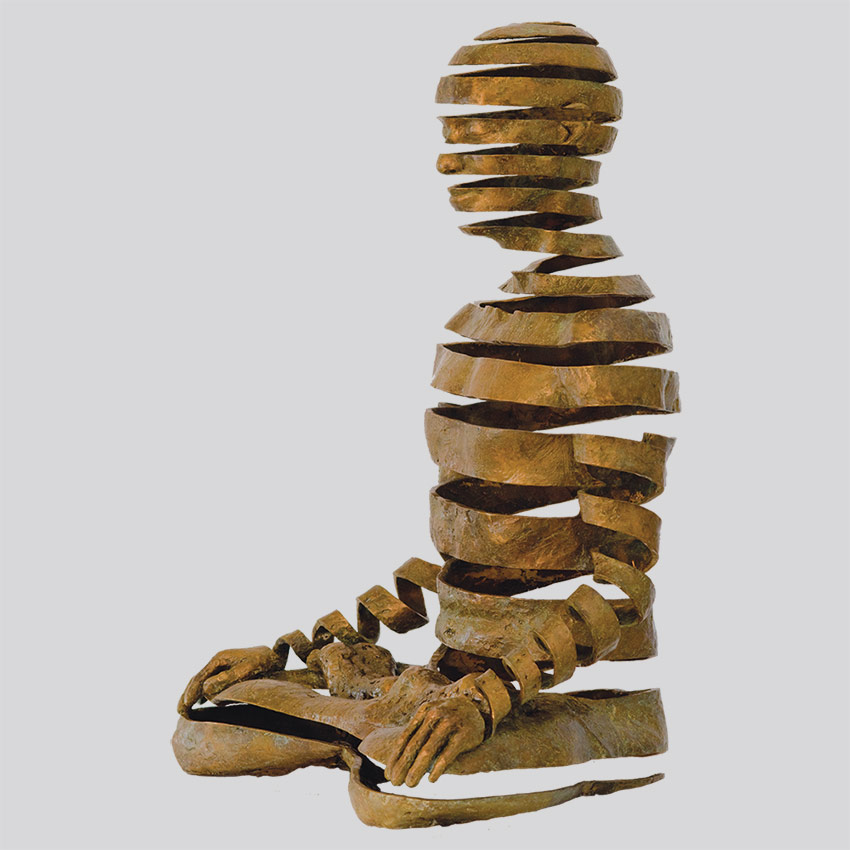
What does this term mean? It has been thrown around alot lately as a criticism of the likes of Derrida and Feminism etc, but I think it’s become a buzzword. Where ever possible I use the terms ‘Post-Structural’ or ‘Post-Humanist’ in its place.
To me, it is an artist statement of post-world war II society, the post-Nietzschean nihilism (nihilism is another word I use sparingly) as in – the values in society of colonialism and imperialism has lost their breadth and were subject to review.
Thoughts on this anyone?
Looking for a foundation
Descartes wanted to find a method that would allow him to be certain about things. He wanted to know if it was possible to sort out what was true and what was false. He lived in a time where science was actually testing what was true and so Medieval dogma was about to be reviewed. He wanted to find an Archimedean point, or lever – which is a hypothetical vantage point from which an observer can objectively perceive the subject of inquiry, with a view of totality. The expression comes from Archimedes, who supposedly claimed that he could lift the Earth off its foundation if he were given a place to stand, one solid point, and a long enough lever. So Descartes was after the ‘unmoveable point’ that would allow him to find certainty.
Descartes is a substance dualist. This means he believed there are two kinds of ‘stuff’ in the universe. There is matter and mind. Matter is extension and mind/thought is cognitive in primary qualities respectively.
He casts doubt on all senses. He even goes so far as to say he can’t tell whether he is dreaming or in wakefullness.
[…]in thinking over this I remind myself that on many occasions I have in sleep been deceived by similar illusions, and in dwelling carefully on this reflection I see so manifestly that there are no certain indications by which we may clearly distinguish wakefulness from sleep that I am lost in astonishment. And my astonishment is such that it is almost capable of persuading me that I now dream.
What he does conclude however, is that we can experience appearances – whether or not they are real or fake, they do have form.
[…]although these general things, to wit, [a body], eyes, a head, hands, and such like, may be imaginary, we are bound at the same time to confess that there are at least some otherobjects yet more simple and more universal, which are real and true; and of these just in the same way as with certain real colours, all these images of things which dwell in our thoughts, whether true and real or false and fantastic, are formed.
He says all the other sciences such as geometry and arithmentic are always very general and simple, they do not ask whether something exists at all. It doesn’t matter whether he is awake or asleep, 2+3 will always equal 5.
He says he is sure of a God creator, but can’t be sure whether or not this creator has made him in such a way that he could be being decieved, there may not be any such earth or heavens, no extended body. The only way he thinks he can be sure is that God is Good and would never decieve him on these matters. He does however consider that there may be a God who is tricking him.
I shall then suppose, not that God who is supremely good and the fountain of truth, but some evil genius not less powerful than deceitful, has employed his whole energies in deceiving me; I shall consider that the heavens, the earth, colours, figures, sound, and all other external things are nought but the illusions and dreams of which this genius has availed himself in order to lay traps for my credulity
Descartes is in danger of solipsism here, or the belief that only he exists (or at least he can only be sure that he himself exists) and nothing else.
In finding whether he can be certain, he is now haunted by doubts.
I suppose, then, that all the things that I see are false; I persuade myself that nothing has ever existed of all that my fallacious memory represents to me. I consider that I possess no senses; I imagine that body, figure, extension, movement and place are but the fictions of my mind. What, then, can be esteemed as true? Perhaps nothing at all, unless that there is nothing in the world that is certain
He asks whether or not it is neccessary to include this God problem. He asks whether he is at least something that is capable of producing these reflections of the mind without a God experiencing through him. He concludes that he definitely exists, whether or not he is being decieved. It is here that he decalres his famous dictum:
Cogito ergo sum. I am, I exist, is necessarily true each time that I pronounce it, or that I mentally conceive it.
I think, therefore, I am. This is the birth of ‘I’ philosophy. He’s not sure exactly what he is, however, only that through a qualitative statement can he be sure he exists and nothing more.
He considers himself to have a body, he refuses to say he is ‘man – the reasonable animal’as that would require him looking into what animal is and so he observes his reflections as they appear to him. He has sensations, which require a body, but this walking and nourishing body would feel the same in a dream and if he was being deceived by an all powerful being. All he can say is – he is a thing which thinks.
He plays with a piece of wax and says he can conclude that vision and intuition allow him to infer the existence of extensions. He cannot percieve it without a human mind.
[…]what I have here remarked of wax may be applied to all other things which are external to me [and which are met with outside of me]. And further, if the [notion or] perception of wax has seemed to me clearer and more distinct, not only after the sight or the touch, but also after many other causes have rendered it quite manifest to me
Ideas, images and modes
He’s reached the limit of what he can know, but it’s rather a big limit. He can only be sure he exists, not be sure what he is. He can be sure that an object (extention) cannot be percieved without a human mind. He has to find a way to be sure that there are two kinds of stuff in the universe, that which he percieves through cognition, intution and understanding and the stuff outside of his mind, the extensions.
And, certainly, since I have no reason to believe that there is a God who is a deceiver,and as I have not yet satisfied myself that there is a God at all, the reason for doubt which depends on this opinion alone is very slight, and so to speak metaphysical. But in order to be able altogether to remove it, I must inquire whether there is a God as soon as the occasion presents itself; and if I find that there is a God, I must also inquire whether He may be a deceiver; for without a knowledge of these two truths I do not see that I can ever be certain of anything.
He divides his thoughts up into two different kinds:
[list=1]
[*]Ideas – the images of the things
[*]Passions – desires, will, fear and other judgements
[/list]If we consider the ideas in themselves, they can’t be false, but the passions may be, he could desire evil things for example, he may desire things which have never existed, but it is not less true that he desires them.
But the principal error and the commonest which we may meet with in them, consists in my judging that the ideas which are in me are similar or conformable to the things which are outside me; for without doubt if I considered the ideas only as certain modes of my thoughts, without trying to relate them to anything beyond, they could scarcely give me material for error.
Some of these ideas appears to be innate and some from other people. Sensations lead him to judge that there are things outside of him that cause the sensation. He hasn’t discovered their true origin yet however. He finds the passions to be the most misleading and although the objects that appear to be outside of him do not depend on his will all of the time, he can’t be sure either way.
He then divides ideas into two categories: adventitious ideas, or happening as a result of an external factor or chance rather than design or inherent nature. The Sun appears to be extremely small for example. Then there are non-innate ideas, from astronomical reasonings that say the Sun is several times larger than the earth.
Representationism
If you take ideas as certain modes of thought, there is no difference or inequality, they all proceed from him in the same manner as discussed. If however, we consider them as images, that one thing represents another – it is clear they are different.
He then thinks of reality in terms of cause and effect. He thinks that something cannot come from nothing. Something which is perfect or great, cannot proceed from something imperfect or lesser, which is to say that causes must be greater than their effects.
[…]if the objective reality of any one of my ideas is of such a nature as clearly to make me recognize that it is not in me either formally or eminently, and that consequently I cannot myself be the cause of it, it follows of necessity that I am not alone in the world, but that there is another being which exists, or which is the cause of this idea. On the other hand, had no such an idea existed in me, I should have had no sufficient argument to convince me of the existence of any being beyond myself; for I have made very careful investigation everywhere and up to the present time have been able to find no other ground.
There cannot be any ideas which donnot appear to represent some things, he concludes.
Substance
Descartes percieves things like stones as being made of substance and he percieves himself to be a substance also. He is the thing which thinks and which does not extend. The stone is the thing which extends and does not think. The qualities are not things from him.
The God bit
God to Descartes is an infinite, independent and immutable substance which cannot have proceeded from himself. From this he concludes that God must necessarily exist. The idea of God is entirely true. God cannot have proceeded from him as he is imperfect.
He does contemplate as to whether there is something more to himself which he is not aware, that potentially the perfectness of God is in him, somehow. He sees no limit on the progression of his understanding and thinks it could possibly be that the Divine could be producing these ideas of perfection in him.
All that I thus require here is that I should interrogate myself, if I wish to know whether I possess a power which is capable of bringing it to pass that I who now am shall still be in the future; for since I am nothing but a thinking thing, or at least since thus far it is only this portion of myself which is precisely in question at present, if such a power did reside in me, I should certainly be conscious of it. But I am conscious of nothing of the kind, and by this I know clearly that I depend on some being different from myself.
On saying that causes must be greater than their effects, there is no way he exists and other things exist solely because of his parents, or some less than perfect being than God. The idea of a being as perfect as God is in him, it was put there when he was created. It is from this state of perfection and incorrputible nature of God, that he concludes he isn’t being deceived.
I recognize it to be impossible that He should ever deceive me; for in all fraud and deception some imperfection is to be found, and although it may appear that the power of deception is a mark of subtilty or power, yet the desire to deceive without doubt testifies to malice or feebleness, and accordingly cannot be found in God.
He believes that God may have given him the faculty to judge error, error is a defect not dependent on God. He’s not satisfied with this explanation however and says error is due to some lack of understanding on his part that he ought to possess. He concludes that God would not give him a faculty of imperfection like this sort.
He puts it down to the fact that there is no way for him to comprehend God in the way that god can comprehend. The causes are transcendental to his own knowledge.
This concludes this thread on Descartes, I will start another one regarding essences of material things.
Philosophy begins with how we can, through reason and rationality, explain most truthfully what there is and how to explain what there is.
We know pre-philosophically that there is guilt and shame for example, so how do we reason this phenomena? I thought psychology would be the place to go, but it’s mostly informed by philosophy anyway.
It’s very difficult to separate psychology from philosophy.
In a previous thread we discussed how philosophy uses language as a logical tool, then it sets out for the application, praxis and the right way to think about life and the disciplines that are necessary to reach understanding. Is philosophy really therapy?
As a personal anecdote, I believe philosophy has helped me overcome many psychological problems of alienation. It has helped me to reach a more compassionate view of life, it helps me to value what is important in life and to approach difficult subjects such as guilt and shame without denial and further destructive tendencies, myself and everyone else in my life.
Philosophy then, to me, is the study of experiencing experience, but I am now looking at some philosophy that appears to be studying the study of experiencing experience. An outside view of an outside view.
Sent from my iPhone using Tapatalk
I created a video this afternoon from my two Derrida posts, will probably create a video regarding Foucault too.
I was just thinking about Derrida’s Theory of Writing and his fascination with a philosophers’ hands, instead of the usual focus on sight from the eyes.
The expression, “Everybody has a book inside of them” springs to mind.
Derrida seems to be more concerned with what goes out of ourselves, rather than what is inside.
I find his expression ‘There is nothing outside of the text’ baffling, and Deconstruction is supposed to be finding Unconscious meaning within ‘texts’, or the ‘traces’, which are like dug out paths in consciousness. Is he explaining human experience as a kind of ‘text’?
Sent from my iPhone using Tapatalk
This would ordinarily be in the lounge, but I thought it could make a fun sticky thread for this section as a work out for creativity!
How to play
The Surrealist Word Game is a word for word pass and play game, so to play, you have to reply with one word per post according to the sentence structure that is decided before the game is played.
[list]
[*]I will construct the first sentence structure to get the ball rolling
[*]Once the sentence structure is complete (when enough replies have been made to finish off the sentence) the next poster must spell out the sentence
[*]Once one game has finished, you may construct a new sentence structure, or continue to use the previous one, or an older one, either way, you must define the sentence structure first.
[/list]
Game one sentence structure
For the game to work you will have to use spoiler code. Here’s how:
[spoiler]insert your words here[/spoiler]You may want to copy and paste this code to make the game play easier.
[spoiler] [/spoiler] Only when the sentence structure is complete can you press reveal. Although I can’t exactly stop any of you from doing this, it’s more fun if you don’t. 😎 Be cool!
The structure is as follows (if you are not sure what the terms mean, please use Google to check them):
[list=1]
[*]Article + Adjective Example: A Defiant In this case you need to post two words in the same post
[*]Noun Example: Lake
[*]Verb Example: Cooks
[*]Article + Adjective Example: A Spiral
[*]Noun Example: Guitar
[/list]
So once you have entered your entry according to the structure, there should be five posts in total, on the sixth post you should post:
A defiant lake cooks a spiral guitar 😀
It’s a crazy game and sure to inspire some crazy looking images for drawing and tatooing onto your body! Your mother will be so proud! haha
Once the sentence is complete, refer to rule 3 in How to Play above.
One post each according to the stucture and go!
My go:
Article and Adjective (You don’t have to post that part)
[spoiler]The simple[/spoiler]
As you can see, I have enabled the spoiler code, please see above to see how to do this. Next word is a Noun.
After Paul alerted me to the great news about Tristram Hunt resigning from his MP position, I was let down when I saw where he was going afterwards – to be the director of the Victoria and Albert museum in London. He had already mentioned charging £5 to enter museums and galleries due to cuts, in 2011, but now says he’s committed to free entry. I really don’t trust this career politician, the Sentinel only talked about him saving art collections and being for brexit, in no way did they mention how he contributed to social services.
What are your thoughts on this guy?
Upon request by Princess, I have added this new section as a sub-section for the Philosophy and Science section. Please fee lfree to share book reviews, drawings, your thoughts on music, history of music, art, literature, how it relates to philosophy etc here. We could also have a ‘what book arewe reading thread or something like that.
Foucault rejects the notion of truth as a matching of correspondence of ideas to things. He also rejects traditional beliefs that western science has been advancing towards this kind of truth. He does not take for granted that it has been advancing in some other sort of way, so rejects the traditional belief in scientific progress. This means he rejects the teleological version of scientific progress.
Foucault tries to see past periods through their own eyes without restrospective selection. He doesn’t only examine the discoveries that are still significant to us today, he examines the failures and more bizarre discoveries, the forgotten areas of human thought. There is no decisive revolution from ideology to science, Foucault avoids using the term ideology , to avoid any suggestion that it means ‘false’ and different to science.
Advent of Modern Medicine
Foucault believes the old medicine man of superstition had the correct view of disease, as something ‘evil’. The discourse viewed disease as counter-life, an evil, negative force. The new discourse around the 18th Century however, disease shows up not as a negative force but as a positive object.
Disease is no longer the ‘invisible other’ of the visible human body. Around the same time as this discourse, pathological anatomy emerged as a common practice, we were opening up bodies all the time to inspect disease actually within organs. This practice only works on dead bodies of course. The new discourse frames disease against a dominant assumption of death.
Disease breaks away from the metaphysic of evil, to which it had been related for centuries; and it finds in the visibility of death the full form in which its content appears in positive terms.
Thinking and speaking about disease in terms of separate static internal organs presupposes death as ‘the concrete a priori of medical experience’.
The object that modern medical science stuidies no longer appears as something natural and obvious; on the contrary, it has to be carved literally or mentally out of the body, by an unnatural act of violence against the body. Nor was the object there waiting to be discovered, it has to be created by a certain practice, pathological anatomy, and a certain way of speaking in terms of separate static internal organs.
A combination of a practice and a way of speaking is what constitutes a discourse for Foucault.
The vaunted objectivity of ‘scientific’ method here consists of tunring the human body into an object for being objective about.
Science is valid, it produces results!
For Foucault, a discourse itself furnishes the very criteria by which its results are judged successful. By other criteria, scientific success appears to be missing the point. The ‘Magic Bullet’ approach to curing infections, the psychological effects of the ‘hygenic’ approach to childbirth, the moral implications of the ‘human vegetable’ approach to maintaining bodily functions at all costs and so on.
Are we not here witnessing the final consequences of a way of looking at the body as though it were dead? Modern medicine has evidently produced its own kind of blindness along with its own kind of visibilities.
Its self confirming nature appears more plainly when it extends its sway from bodily health to mental health.
Psychiatric medicine depends on the authority figure of the doctor.It didn’t introduce science, but personality. Patients are pursuaded into speaking a scientific language about themselves, they are ‘mad’ because they have evaded primary socialisation which ordinarily enters into human beings along with their societies language; but they can be subdued and at least partially socialised by a secondary web of restraining language.
The ‘successful’ result in no way proves the psychiatrists language. They have not caught the truth of madness with their language, he has merely taught it to speak the same language back to him.
Episteme
There was a new conceptual framework for psychiatrists and doctors in which they placed their ‘scientfic’ object. These large scale conceptual frameworks is what Foucault calls episteme.
The episteme is a social a priori of a kind that preceeds any possible original discovery and any possible truth to the world. It is social because it is spoken together before it can be spoken individually. It preceeds any possible truth about the world because it is a priori therefore must constitute the very ground upon which truth and falsity can be debated. Foucault does not deny that theories may be more or less true and more or less original within an episteme.
Between epistemes however, he proposes a discontinuity so deep and unbridgableas to be beyond even conflict and disagreement.
Hegel
Hegel proposed a history that woud deal with much more than things in the world – a ‘philosophical’ history as distinct from the ‘anti-universal’, ‘pragmatic’, ‘critical’ and ‘fragmentary’ varieties of factual history. He developed the outlines of such a history in his account of the very general frameworks, or zeitgeists, that have dominated the successive periods of human thought. The Roman period was dominated by the concept of law for example.
These are rather crude and simplfied compared to Foucault’s epistemes, but Hegel did at least objectify objective ideas in social customs and institutions. He makes them dependent upon a given state of society. He relativises the concept of a priori in his Objective Idealism.
Foucault on the subject of those who do not conform to their society’s social a priori, gives us more than Hegel who does not even allow for the possibility of non-conformity. For Foucault discovers in the unrecorded and unrecordable side of history that the mind of the excluded that does not conform is treated as abberational, as mad, as perverted.
Foucault was at least happy with periods of overt social coercion,but resents how thanks to science, coercion has become insidious. Oppression by the smug superiority of ‘knowledge’ is particularly oppressive.
He looks through history,
[list]
[*]There were no human sciences during the Renaissance because there was no human object of knowledge
[*]In this episteme, the division between the human and the non-human does not exist
[*]By way of God, the whole world is a cultural project
[*]Natural world appears as a great artifice, a great book that God as Word itself inscribes signs and clues and an endless play of overlapping resembalances for men to interpret
[*]As the natural world is a kind of language, so human nature is a kind of nature
[*]The fables of extraordinary plants are just as reliable as seeing them with first hand experience
[/list]
What seems like subseervience to ‘authority’ is really the consequence of a totally different epistemological framework. In the Renaissance, language is ot regarded as a secondary human creation always liable to diverge from the primary world, it is a part of the world, ontologically interwoven with it.
In the Classical period the non-human splits off from the human. The natural world becomes an object to be known by the human mind as a subject. First hand observation depends on a single sense – sight. This is better suited to the ‘hard’ natural sciences.Wealth was seen as something ‘in nature’, in Economic studies. It’s nothing more than the nomination of the visible when observing the natural world of plants and animals.
The 18th century, the focus shifts from the mechanical interactions of solid bodies to insubstantial functionings of forces like electricity, heat and magnetism; Nature ceases to be an ‘object’ in the simple ‘thing-like’ sense of the term. Forces as they are in themselves are out of reach for sight; they can be known only by understanding, only in the abstract.
Economics and language suddenly took on a ‘hidden’ status too, they contain hidden forces.
Modern Period
The Modern Period invents a new image of man that recuperates his importance and apartness – a step in the wrong direction for Foucault. The image of psychological man.
This is evidenced by the rise of the ‘I’ Philosophers – psychological philosophy, such as Kant, the Phenomenologists and Existentialists. These created the human sciences, the ytruly human ‘human’ sciences for Foucault are sociology, psychology and anthropology. The human subject swings around on the side of the object. A dichotomy appears between the human and non-human, but within the human itself.
Subject and object come up face to face, side by side, once more. Man’s experience is still directly observable, even if the ‘forces’ hidden behind it are not.
The stream of consciousness within the alt-right I believe is in the thought of Jean Baudrillard and Alain De Benoist, both of these thinkers have had a massive influence over the New Right, Baudrillard influenced the themes in the Matrix movies, which as we know has become a powerful analogy for Alt-Right thought (hyper normality, simulacra etc). Benoist has spoken at the National Policy Institute (NPI) too. They are the right wing of Post-Modern philosophy.
The influence of Nietzsche on these thinkers is also of significance, as they take his master-slave view of social interactions to the extreme. One has to look towards thinkers like Michel Foucault, Jacques Derrida and Deleuze and Guatarri for a more left leaning version of Nietzsche’s process philosophy, as they explain the herd instinct in terms of defiance and resistance, as opposed to weakness as strength.
They also don’t fall into the trap of Post-Truth (Post-Humanism) and nihilism, instead Foucault can offer an account of the body as a force, that power circulates in a capillary fashion through society and truth is a discourse that has created concepts such as identity out of oppression.
They are Anti-Humanist thinkers, looking for a balance between rationality and feelings and do not exclude the power that comes with truth. Benoist develops concepts of sovereignty and the friend-enemy relationship of Carl Schmitt (perhaps the most important political thinker of modern times). Also, check out his concept of Ethno-Pluralism, which is a fancy term for Nationalism.
Benoist at least is anti-capitalist, which is one way in which he attracts those who are more left-leaning. He also focuses on old Pagan beliefs as the ‘true’ identity of Europeans. Benoist has given the Right as form of identity politics, whereas Foucault sees identity as a creation of Humanist and Enlightenment thought, he sees the dynamics of power as much more significant, but it’s not power and coersion in terms of battles and wars, it’s more of a power that is exercised over and of bodies through cultural norms, performance, repeated actions, mimesis and normativity that then forms our subjectivity.
The power over the body is the force that partakes in ritual and ceremony, whereas power of the body is the source of our own will and desires, it is the source of revolution and resistance.
Basically, Foucault takes the ‘I’ out of the equation, as did David Hume during the formation of truth in the Enlightenment. Foucault seeks to inspire resistance in minorities and prisoners, a way of looking at power which is so deeply ingrained in our bodies that it is impossible to eradicate.
Where as Benoist seeks an identity politics of friends and enemies, Foucault brings us to a monism that we are all expressions of the Will to Power and seeks for a way to loosen up power structures so that hierarchies don’t become too fixed – in short, Foucault is against domination and acknowledges that whereever there is power, there is always a continuing resistance.
Foucault also rejects Marxist (Hegelian) progression through history towards an ideal.