
Post your images from walks in the countryside.


Four Main Theoretical Perspectives
Feminism has four main frameworks. There is a fifth, which I will include towards the end of this thread. I’m hoping to make a few threads that cover the basics, not just for others to read and discuss on the forum, but to also clarify the basic positions for myself. I have posted it in the ‘Philosophy and Psychology’ Section, as there is no Sociology section, or human sciences section.
Before we commence the thread, I am aware of the internet raging war of feminists and anti-feminists, MRA’s, MGTOW’s, SJW etc…I ask that the threads I post on this subject be disassociated from these terms and their many, many meanings. Feminism is a social study, it also has philosophy associated with it. Some of the following forms of gender inequality may not exist, or exist in the same form, but in order to understand the frameworks, I will have to consider these analyses as they are. Patriarchy has shifted mainly from private inequality to public relations over the years.
Take this for example:
Women do more work in the household than men.
I emplore anyone reading this to not take offence, if you do happen to do equal or more housework and you are a man, good for you! This is a private issue for feminism to tackle and may not be a prevelant in society as it once was, but this is not to say that it isn’t happening in the world today on large scales, take Islamic cultures for example, which have a very strict patriarchal structure of society.
I find feminism is only possible to understand objectively, if you can distance yourself from the considerations. While feminism, in its varying forms, may seem like an attack on men, even as if it is men-hating in general, I have to say I don’t see it that way and niether do I proffer such a view. Feminism discusses issues where they happen and how they happen.
This thread is not going to tackle feminism as ‘the fight for equality for both sexes’, rather it is to explain the differences between the frameworks and how they approach the subject. It is not to be taken as an activist thread. I am only atempting to convey what is actually written about in feminist texts. Feminism is a subject that can’t be discussed in isolation, the context is vast.
The four main perspectives are:
[list]
[*]Radical Feminism
[*]Marxist Feminism
[*]Liberal Feminism
[*]Dual Systems Theory Feminism
[/list]
The fifth perspective, which is the one I personally find the most interesting, is the Post-Structuralist school of thought on Feminism. We will get around to this.
Radical Feminism
Radical Feminists have an analysis of gender inequality in which men as a group dominate women. The system of domination is called patriarchy. Radical Feminists do not percieve patriarchy as being derived from any other social system of inequality; for instance, it is not a bi-product of capitalism.
‘The personal is the political’, is a slogan that questions who does the housework, who interrupts whom in conversation – these are seen as part of the system of male domination.
There are differences between Radical Feminists over the basis of male supremacy. This is often considered to involve the appropriation of women’s sexuality and bodies.
In other accounts, male violence is seen as the root cause. Sexual practice is seen to be socially constructed around male notions of desire, not women’s. Sexuality is seen as a major site of male domination over women, which men impose their notion of feminimity on women.
Heterosexuality is seen as the norm, socially institutionalised and this oragnises many other aspects of gender relations.
Male violence against women is considered to be part of a system of controlling women.
The main problems critics have raised about Radical Feminism is a tendency towards essentialism to an implicit or explicit biological reductionism and to a false universalism which cannot understand historical change or take sufficient account of divisions between women based on ethnicity and class.
Marxist Feminism
Marxists differ because they consider gender inequality to derive from capitalism, therefore patriarchy is not to be considered as an independent system.
Men’s domination over women is a by-product of capital’s domination over labour. Class relations and the economic exploitation of one class by another are the central features of social structure and these determine the nature of gender relations.
The family is considered to be beneficial to capital by providing a cheap way of taking care of workers, cooking food, washing clothes and for producing the next generation of workers. An important book to read is Silvia Federeici – Caliban and the Witch, in that book, she describes the onset of capitalism during enclosure and how women were subordinated into these roles in society. Women recieve maintainence from ther husbands, but pretty much perform these duties for free.
Capital benefits from the unequal division of labour in the home.
Other Marxists are not so economistic.
Some Marxist Feminists retain a materialist analysis of class relations and combine them with gender relations in terms of ideology and culture.
The main problem is that it too narrowly focuses on capitalism (although this does not make them irrelevant – see my threads on capitalism for more on this). It is unable to account for pre- or post-capitalist societies and it incorrectly reduces gender inequality to capitalism, rather than recognising the independce of gender dynamics.
Liberal Feminism
Liberalism differs from both of the other analyses. It doesn’t have an analysis of overarching social structures, but rather percieves doination as being the result of numerous small scale deprivations. In other words, they reject false consciousness and instead focus on rights.
There are two main strands of analysis:
[list=1]
[*]The denial of equal rights for women In education, employment and other important concerns. Women’s disadvantaged position is related to specific kinds of prejudice against women.
[*]Sexist attitudes that sustain situations Attitudes are analysed as traditional and unresponsive to recent changes in gender relations.
[/list]
Liberal Feminists have provided extensive documentation and data, empirical studies, on the lives of women.
The major surveys on women’s employment and divsion of domestic labour might fall into this category.
Liberal feminism fails to give an account of deep rooted gender inequality and the interconnectedness between its different forms. The persistence of patriarchal attitudes is not systemactically addressed, leading to partial accounts.
Dual Systems Theory
This is a synthesis of Radical and Marxist Feminism. It argues that patriarchy and capitalism are both present and important in the structuring of gender relations in society.
They either analyse it as a capitalist-patriarchal system or as a system that is so symbiotically closely related that it eventually becomes one system.
Patriarchy sustains a system of law and order, while capitalism seeks the pursuit of profit. Changes to one part, will result in changes in the other. Increases in demand for women in the work force for example, leads to demand of political change, in the increasing contradiction of women who are both wage-workers and domestic labourers.
Other writers keep them seperate. On the economic level, order is maintained by capitalism, while on the unconscious level, patriarchy holds the law. This framework was taken from Sigmund Freud, whose work is often considered anti-feminist, due to sexist intrepretations of women’s sexuality and desires, nevertheless was found useful for this framework.
Other writers consider patriarchy as operating at the level of expropriation of women’s labour by men. Segregation of the workforce is also taken into account. Occupational segregation is used by organised men to keep access to the best paid jobs for themselves at the expense of women. Women also perform more duties at home than men do. Women’s disadvantaged position in the workforce makes them vulnerable in marriage arrangements.
Dual Systems theorists state that patriarchy existed long before capitalism, so it cannot be reduced to it.
The main problem I have with Dualists is that they do not cover the full range of patriarchal structures. Sexuality and violence are not given much analytic space. Most suggest either material or the cultural levels are the basis for patrairchy. A broader range of structures needs to be addressed.
Radical Feminists have contributed primarily analyses of sexuality, violence, culture and the state, socialist feminists on housework, waged work, culture and the state. A proper synthesis should include –
[list=1]
[*]waged work
[*]housework
[*]sexuality
[*]culture
[*]violence
[*]the state
[/list]
Post-Structural Feminists
These feminists draw from the works of Derrida and Foucault, while they were not feminists themselves, their texts contain many useful resources for feminists. Although Foucault makes few references to women or to the issue of gender in his writings, his treatment of the relations between power, the body and sexuality has stimulated extensive feminist interest.
The deconstruction of specific categories in texts by Derrida has advanced feminist analysis within the field of cultural studies.
Foucault sees discourses as power, but it is very dispersed and capillary. This is a very different view of power compared to all the other theoretical perspectives. Foucault’s idea that the body and sexuality are cultural constructs rather than natural phenomena has made a significant contribution to the feminist critique of essentialism.
Judith Butler, another Post-Structural Feminist also works with Queer Theory. Queer theory is a multilayered, and rather complex, field of study. To assign a single-sentence definition to this theory would be incomplete as it would fail to touch on the various ways it is interpreted, applicable and used. In particular, Queer Theory’s overreaching goal is to be sought out as a lens or tool to deconstruct the existing monolithic ideals of social norms and taxonomies; as well as, how these norms came into being and why. In addition, it analyzes the correlation between power distribution and identification while understanding the multifarious facets of oppression and privilege. It is vital to understand queer and Queer Theory as an applicable concept providing a framework to explore these issues rather than an identity. Queer is an inclusive umbrella term for those not only deemed as sexually deviant in relations to a social hegemony but also used to describe those who feel marginalized as a result of social practices and identity. It is a “site of permanent becoming”.
Feminism, perhaps more than any other movement against domination, has thought hard about how projects of personal change can and must interact with social struggles. In some early forms, feminism was typically conceived of as the struggle of women to transform their relationship with men. A simple reading, along the lines of the Clausewitzian image of the duel, would see this as a project in which one social body (women) confronts another (men) and seeks to reconfigure the power relation between these two groupings. However, it has become apparent to more recent feminists that any such project is also a project of self-transformation, in which the identity of ‘woman’ is itself put into question.
The identity of ‘woman’, understood as a fixed natural kind, is a ‘myth’, an ‘imaginary formation’. At the same time, it is certainly the case that in our current world some people are identified – or marked, as Wittig puts it, citing Colette Guillamin – as women. They are identified in this way not only by (those marked as) men, but also by others marked as women and, in many cases, by themselves. And this marking is not merely a superficial naming but:
ideology goes far since our bodies as well as our minds are the product of this manipulation. We have been compelled in our bodies and in our minds to correspond, feature by feature, with the idea of nature that has been established for us.
The project thus involves a movement between two different schemes of identity, two ways of grouping a social ecology. Now, in the present, and formed historically by past relations of domination (and so also by past resistance), there is an identity scheme in which human beings are classed as men and women. The future goal of the project is a quite different identity scheme.
At this point, let us say that a new personal and subjective definition for all humankind can only be found beyond the categories of sex
In Nomadic Subjects, Braidotti’s feminist project embarks from the point that ‘there can be no subjectivity outside sexuation, or language; the subject is always gendered: it is a “she-I” or a “he-I”’.
The tense of this ‘always’ is not entirely clear: if it means that we can’t imagine any potential future form of language and sexuality without binary gender, this opposes Wittig’s project from the start. On the other hand, we might read it to say that people living now have (with few exceptions) grown up gendered as male or female. Braidotti’s account of sexual difference then deepens the conception of how humans are ‘marked’ by gender from birth through infancy and as we learn to move, to speak, to value and interpret the world, to experience and shape our bodies, to identify others and ourselves as subjects and as objects and as members of groups, and to practice domination and resistance.
Both projects develop around three distinct perspectives, or moments, of identity. For both, the starting point is a past and present definition of ‘woman’: an identity that is shaped by a history of domination and struggle, but that lives very much in the present as it is deeply incorporated into bodies and relationships here and now. Second, both projects move towards a future in which gendered identities will be transformed: whether, for Wittig, destroyed outright; or, for Braidotti, remade. Thirdly, to reach this future involves the formation of more specific alliances, communities and forms of life, that are actively engaged in resistance here and now: ‘feminists’, ‘lesbians’, ‘feminist women’.
The feminist projects, are collective projects: rather than isolating herself, the self-transforming subject finds or creates an alliance, a community of subjects. who work together on their overlapping projects. Here the project form of life is a collective form of life – perhaps indeed, a culture – that takes shape through the interactions of a group of allied bodies.
In 2011 China became the world’s largest producer of manufactured goods, overtaking the United States, top producer for the last 110 years. China, India, and other Asian countries are now the ‘factories of the world’, the main centres of production for most of the tangible things we buy and use, from cars to computers to crockery. Just as they were 200 years ago, before European capitalist expansion.
Other ‘developing countries’ in Latin America, Africa, the Middle East, as well as Russia, provide most of the basic raw materials – fuel, metals, minerals, etc. – to run those factories. The ‘developing world’ – or should we now call it ‘the producing world’? – also produces most of the world’s food.
But all this wealth is still largely consumed in Europe and North America. How does that work? And how long can it carry on?
A recap: the pursuit of profit
Capitalists chase profit. They can make profit ‘directly’ by producing and selling commodities. Or ‘indirectly’ by getting interest from investing finance capital; or by acting as middlemen, for a fee. Profit = revenues – costs. So to boost profits producers need to increase revenues, or reduce costs. To increase revenue they need to find higher demand for their products: more buyers; or buyers who will pay more. There are two main routes to reducing costs: more efficient production technologies; or cheaper inputs. New inventions and technological advances boost profits and production. So do finding new sources of cheap materials – or cheap labour. So the hunt for profits drives the expansion of capitalism in a number of ways, as capitalists try to find or create new markets.
New consumer markets to buy their goods; new sources of raw materials; and new sources of cheap labour.
Global incomes
The table below shows some of the global income statistics estimated (or ‘guesstimated’) by the economic historian Angus Maddison. They calculate income as GDP per person (annual income measured in 1990 dollars).

Oops! Where it says ‘1920’, it should say ‘1820’, my bad!
Of course, these figures are mostly just wild guesses, and ignore massive differences in economic systems. Including differences in what cultures consider as tradeable commodities at all. But they at least bring out some basic points. If you do measure prosperity in terms of the sheer quantity of tradeable stuff around, then the world has got much richer under capitalism. Average incomes around the world stayed pretty much the same in the centuries before the industrial revolution and capitalist take-off. China had more stuff than Europe in the millennium or so after the fall of Rome, but not dramatically more.
Then it all took off. In the early nineteenth century European and North American income was double the levels in the rest of the world. But this was just the beginning. By 1900 the US produced seven times more (per person) than China. By 1970 it produced 20 times more. World income has doubled again since 1970. This includes the ‘developed world’. But the most growth is in Asia: China has grown nine times richer, India four. Only Africa has been left out.

Map resizing countries based on their GDP
GDP?
GDP stands for ‘gross domestic product’. Roughly, it means the value of all the marketable goods and services produced in a country. Economic growth is the increase in a country’s GDP over time. GDP per capita is the country’s GDP divided by the number of people in the population: i.e., the average GDP. Economists use GDP as the standard measure of economic wealth and prosperity. And, often, as the measure of all goodness and ‘progress’ in the world. But focusing on GDP hides many issues. Average GDP figures ignore the inequality of income distribution within a country. GDP statistics only reflect production that is known to the state, usually recorded in tax returns, and so ignore unpaid and unseen work: including domestic work, largely done by women; or ‘black’ work, like the work of illegal migrants. And, of course, GDP only measures commodities, things that can be bought and sold in markets. Using GDP as a measure of goodness or ‘quality of life’ supposes, as economists standardly do, that our well-being just involves accumulating and consuming commodities.
Why is economic growth the one great goal of democratic politics? Policies that chase growth certainly help capitalist profits. And they avoid questioning the distribution of wealth: if everyone gets richer as the economy grows, we can all have more stuff without having to take it away from the rich. Questioning the distribution of wealth is labelled the ‘politics of envy’. Questioning the very idea of commodification, of economic growth, or of what never-ending increased production means for our planet, is just crazy talk.
What explains global income inequalities?
Neoliberal economists argue that it is all about the internal systems of countries. ‘Poor’ countries (Latin America, India, Africa, etc.) have failed to keep up with world growth because of weak institutions: corruption, weak democracy, and above all a lack of strong property law. (The Peruvian economist Hernando de Soto is the master of this line – see his ‘The Mystery of Capital’.)
So is it just a coincidence that these ‘poor’ economies used to be colonies of the successful capitalist nations?
Core and periphery

According to the ‘world systems theory’ of capitalist development, political-economic systems typically have a core and a periphery. The core is where high-technology, high-skilled, capital-intensive, production happens. These are usually the later stages in the production process. The periphery produces the raw materials which are shipped to the core. Some of the finished goods may then be shipped back to consumers in the periphery. The core is also where trading and organisation functions, such as financial markets, are based.
This division of labour makes the periphery dependent on the core: it cannot produce the finished goods on its own. Strictly speaking, core and periphery are dependent on each other. But the core has the advantage as its goods are more specialised, harder to produce, and more prestigious.
Imperial history
In pre-capitalist civilisations, and in early capitalist Europe, commercial cities were cores, producing and trading the advanced goods; the local countryside was their periphery. Colonialism made core/periphery systems go global. In the 19th century, Britain was the biggest ‘core’ of the global trade system. Its products involved skilled labour, for relatively high wages, and advanced technology. It was also the site of the financial markets.
The ‘periphery’ of the empire produced the raw materials. The early economic role of the United States was largely as a mass grain producer for the Imperial market. India’s own cotton manufacturing industry was destroyed, and India became an intensive producer for raw cotton shipped to the mills of Lancashire.
The Atlantic Slave Trade and Indentured Labour provided cheap or free labour for agriculture and raw materials production. How did Britain become dominant? Britain’s initial advantage came from new technologies: not only cotton mills and steam engines, and new weapons; but also new financial, legal, and cultural ‘technologies’.
Technology gave British industrialists a competitive advantage – they could produce better goods, more cheaply – and their manufactured products took over world markets.
Where capitalists in other countries could not compete with British manufacturing, their profit opportunities came from exploiting cheap labour and natural resources to produce raw materials. So the local capitalists – plantation and mine-owners, etc. – of periphery countries also gained in the core/periphery division.
Imperialism involved both market power and military power working together. Technological advantage gave the British capitalists their initial market power. As they accumulated wealth and capital, market power was further increased by the sheer size of their resources. The British state used its share of this accumulated wealth to create the world’s most powerful military machine. Business and government worked together to ‘open’ new markets and property systems with a mixture of trade and force. This did not always require direct colonisation: e.g., in the Opium Wars, and the smashing of the Boxer Rebellion, Britain and other capitalist states forced the Chinese government to allow the trade in opium and other goods.
Nor should we ignore cultural power: missionaries, doctors, teachers, and other settlers, helped spread the new values, norms, and desires of the capitalist property system.
Hegemony?
The Greek word hegemon (ruler, leader) is sometimes used for a state like Britain in the 19th century, or the US and USSR in the 20th, which dominates world politics and economics. But this concept shouldn’t be over-used. In the 19th century, there were large areas of the world still uncolonised. For much of the 20th century there were two main rival powers. Even on its own home turf, a state or elite’s power is never total: there are competing factions and interests within the elite; and free spaces and pockets of resistance where domination is much weaker.
‘Development’
How can a country move from periphery to core? The problem is that advanced manufacturing production needs serious capital investment: factories, complex machines, energy plants, transport infrastructure, etc. These advanced goods are very profitable – but you need massive investment to get started. And that is assuming core producers allow access to advanced technologies and markets.
In the early 19th century the US was still a periphery country, producing grain and cotton for the British empire. But this was profitable business, and US capitalists were able to build up a surplus of finance capital for investment. They started to invest it in building up local manufacturing industry which could eventually compete with Britain. Some of the reasons they succeeded were:
• they had big enough capital reserves for the initial investment;
• new technologies – including ‘Fordism’, the production line methods pioneered by Ford Motors — gave them an advantage;
• whereas Britain was stuck in old technologies – and with all their existing infrastructure in place, it was expensive for British capitalists to switch to the new American models;
• they had cheap labour from mass immigration, whilst British labour was getting more expensive, due to workers organising and fighting;
• alongside the development of manufacturing, the US state and capitalists built up local financial markets, so that industrialists didn’t have to go to London to raise money;
• protectionism – the US government offered support to domestic industry by imposing high taxes (trade tariffs) on imported goods;
• but protectionism is only possible if existing core states allow it – the decline of British military power meant the empire was too weak to use force to defend ‘free’ markets for its goods.
Kicking away the ladder
In the 1950s and 60s, ‘third world’ states in Latin America and Asia tried to follow the US example and use protectionist policies to develop national manufacturing industries. This policy was known as ‘Import Substitution Industrialisation (ISI)’ – building industry to substitute local products for imports of advanced goods. They used import tariffs and state subsidies to ‘nurture’ ‘infant industries’. ISI largely failed. These countries were not strong enough, economically or militarily, to take on the US. If they introduced import tariffs, core countries could retaliate with tariffs attacking their exports. Most of their income still came from exports, and local consumer markets could not fill the gap. The rich elites could afford to buy better quality imported luxuries. Most locals were just too poor to buy anything.
And if these trade wars weren’t enough to keep third world states in their place, the US could resort to other means. Across Latin America in the 1970s, the US launched coups to impose governments that dropped ISI and kept to their place as raw material exporters. (See William Blum’s ‘Killing Hope’ for a bloody history of US military interventions since 1945).
The price of our blood, sweat and tears

GDP averages hide the vast inequalities within countries. And inequality in ‘third world’ countries is typically more extreme than in ‘developed countries’, where workers’ movements gained some concessions like higher wages and welfare services. Here are some figures on average pay in manufacturing industry, as estimated by the US Bureau of Labor Statistics. Note: these figures are estimates of total ‘compensation costs’, i.e., not just cash wages but also other costs paid by employers such as tax and national insurance, health insurance and pension contributions, etc.
Note: all data are for 2012, except China 2009 and India 2010. The US statisticians say that the data for China and India are much less accurate and transparent.
Investment vs. consumption
The table above shows that manufacturing pay in the US and rich countries of Western Europe is more than 20 times higher than in China. But remember that the first table in this thread showed that US GDP per head is 4 to 5 times higher than in China. So: not much of China’s rapidly growing wealth is paid out to the factory workers fuelling its economy. Where does it go? Some goes into the pockets of China’s new rich. Much of it, though, is not consumed but invested back in production. I.e., spent on new capital: new factories, new machines, more raw materials and energ y, to produce even more stuff. GDP is, effectively, the total revenue from all the production of a national economy. As we saw in Chapter 1, some of the revenue of a capitalist production process goes to cover the costs: wages (labour costs); raw material costs; and finance costs (interest payments). The rest is the producer’s profit. Out of the profit, the capitalist has to decide how much to re-invest in future production; and how much to ‘consume’ herself.
We can do the same kind of breakdown on a bigger (national) scale. GDP is the (money) value of all stuff produced in a national economy. Some of that stuff will go to workers, as wages. Some will go to capitalists, investors, e.g., through interest and share dividends. Some will go abroad (exports). Some will go to the government, in taxes from workers and investors and on exports.
There are two things that workers, investors, and governments can do with their share of the national product. They can consume it, or save it. What is consumption? Roughly: if a commodity is consumed, it is taken out of economic circulation. If I eat (consume) a chocolate bar, it leaves the economic system and enters my digestive system. It can no longer be traded, or used as raw material for a cake. Alternatively, I can hide the chocolate bar under my bed for a rainy day. This is a form of saving. But, on the whole, most people with money don’t save it by hiding it under the bed. They may deposit it in banks, who then lend it on. Or they may invest it in property, shares, bonds, and other markets. These forms of saving thus involve re-investing capital, through financial markets, back into production. Thus a basic assumption of macroeconomic theory: Savings = Investment.
The share or percentage of income that is saved and invested is called the savings rate. There is a lot of discussion amongst economists about how people make ‘savings decisions’. Generally speaking, the more income people have, the more they are likely to save. If your wages are near starvation level, you will spend everything you earn to stay alive.
Here are some World Bank estimates on national savings rates (as a percentage of GDP):

How does that add up? People in China and India are, on average, much poorer than people in the UK and Europe. And poor people usually consume a higher proportion. But, luckily for their rapid economic growth, Chinese and Indian ‘national incomes’ are far from distributed equally amongst the population. Besides the ‘new rich’, who do their best to spend at least some of it on luxury living, a lot of China’s income is still controlled by the State and state-linked corporations, who pursue a planned policy of investment and growth. Not all strongly hierarchical and authoritarian economies are booming ; but inequality and centralised control certainly can be key factors in rapid growth.
Global shift
I made a list above of some of the reasons why the US was able to successfully escape its ‘periphery’ status and overpower British hegemony. Now we can see how China, and also India and other former ‘third world’ economies, fit the picture.
• investment capital: accumulated through high national savings, largely centralised and controlled by the State and mega-corps;
• cheap labour: millions of impoverished rural labourers flocking to the cities in search of work, in scenes reminiscent of the birth of industry in Europe, only on a much bigger scale;
• new technologies: production line industry taken to a new scale.
There are also differences. China and India do not follow the import substitution model. Their manufacturing is mainly for export. Local consumer markets are developing, but not fast enough to keep up with production. (Which is why Chinese capitalists are still at risk from the global depression – they need us to keep consuming their products.) Their products directly out-compete manufacturing in the old core, mainly due to much lower wage costs. So they do not need to rely on protectionist import tariffs. What does benefit them is to keep their own currencies low, making exports even cheaper. The trade wars rumbling between China and the US have been about currency ‘manipulation’ not protectionism.
China has been winning these trade wars. The US now has neither the market power nor the military power to take on China. Like Britain 100 years ago, it has burnt out its economic and military resources maintaining a dying empire, see my replies to Mider in his Donald Trump thread, getting caught in costly and pointless wars. All the old hegemon can do is grumble.
Once more, financialisation
US economic independence from Britain also involved the development of financial markets in New York and Chicago to rival London. New financial centres – particularly Hong Kong, but also local markets elsewhere in Asia, and in Latin America – are developing.
But what’s interesting is that the markets in London and New York have been growing even faster. ‘First world’ GDP has been growing much slower than in the ‘emerging markets’; ‘first world’ manufacturing is in decline; the only part of the first world economy that races ahead is finance.
A couple of things really show the shift towards finance in countries like the US and UK. One is where profits come from:
1960s: financial profits were 15-20% of all profits in the US;
2000s: they were 35-40%
Source: Foster & Magdoff
The other thing is the work people do. Here are some employment figures from the UK (sources: Graham Turner; Office for National Statistics):

The famous ‘destruction of British manufacturing’ which started under Thatcher continued apace under Labour. By 2007, over 7 million people were working in finance. Another 7 million people were making them cappuccinos.
Vendor financing
The question: if US and UK industry has died or, at best, stagnated, what are these bloated financial markets actually financing ? The answer: a massive consumer debt bubble. How does the first world pay for all those imported goods? By borrowing from the productive world. I will look more at these points in the thread after the next one.
“The simplest answer is the one we immediately take as our own, as if we came up with it ourselves.” – Chuang Tzu
How do we know if something is true? Does correct mean it has to be “true”? If it’s true, does it have to mean something? How do we know anything if we know nothing beforehand about something we claim to know? Do we discover, or invent ideas? Do ideas come from another world? Are those ideas the same as the numbers and language we describe them with? Do we have to obey the truths we discover or invent?
Occams Razor is the main aim of any philosophical, spiritual, scientific or mathematical investigation – The principle states that among competing hypotheses, the one with the fewest assumptions should be selected. Other, more complicated solutions may ultimately prove correct, but—in the absence of certainty—the fewer assumptions that are made, the better.
This requires disclosure of beliefs. This is not to be taken in the context that we are competing to win or lose something, it’s just that we often have a number of perspectives and ideas that may all be correct, it’s just that we want the simplest one.
The question is, how do we get to this?
There are many important factors to take into account – we often use language and mathematics to create what is called a “schema”, which is an organised pattern of thought that organises categories of information and the relationships between them.
We use “syntax”, which is the study of principles and processes by which sentences are constructed in particular languages.
As regards language and mathematics – we can say that we use them both in the same way. The simplest way to understand both of them, is that we put numbers and words together to create a picture of reality – this gives us definitions.
There are two philosophers of mathematics and language who are worth taking note of here – Ludwig Wittgenstein and Blaise Pascal.
Wittgenstein looked at the definition method of “Ostensive Definition”, which is “meaning by pointing out an example”. As regards mathematics and language, again, we are attempting to create a picture of reality by constructing a sentence and the main aim is to bring forth a meaning from the definition and let us not forget that we must do this simply.
“So one might say: the ostensive definition explains the use—the meaning—of the word when the overall role of the word in language is clear. “
Schema, Syntax, Definition, Meaning and now Use!
Pascal then brings into this problem of explanation what can actually be known. Pascal divides definitions into two different types – essential definitions, which are self supporting statements that require no reference to understand their definition and meaning such as the word “Bachelor”, as all bachelors are unmarried males. Then there are an unnamed type of definition, which I will call empirical/falsifiable definitions – they are to be tested as correct or false, for instance, the statement that “all bananas are yellow” can be tested and invariably, we will see that all bananas are not yellow, some are overly ripe, stale or not quite ripe, which leads us to categorisation, or rather “abstraction”.
We require something called an axiom, or postulate, which is a premise or starting point for reasoning, when we use an axiomatic system, or method, we conjoin all axioms to create a theory.
Pascal saw these methods for making principles from postulations and premises as a problem, particularly in geometry and its’ axiomatic method, he looked much deeper into the question of how people become convinced of the premises for which later conclusions are based. Pascal said that achieving certainty in these axioms and conclusions through human methods is impossible. He asserted that these principles can be grasped only through intuition, and that this fact underscored the necessity for submission to God in searching out truths.
He said that discovering truths, arguing that the ideal of such a method would be to found all propositions on already established truths. At the same time, however, he claimed this was impossible because such established truths would require other truths to back them up—first principles, therefore, cannot be reached. Based on this, Pascal argued that the procedure used in geometry was as perfect as possible, with certain principles assumed and other propositions developed from them. Nevertheless, there was no way to know the assumed principles to be true.
In other words, we can only know something based on what we know already.
Mathematics as Human Invention: According to Wittgenstein, we invent mathematics, from which it follows that mathematics and so-called mathematical objects do not exist independently of our inventions. Whatever is mathematical is fundamentally a product of human activity.
Arithmetic does not talk about the objects it measures, it operates with them in the picture we create. This is contra Platonism that states : that the world was, quite literally, generated by numbers. The major problem of mathematical Platonism is this: precisely where and how do the mathematical entities exist, and how do we know about them? Is there a world, completely separate from our physical one, that is occupied by the mathematical entities? How can we gain access to this separate world and discover truths about the entities?
Tegmark’s mathematical universe hypothesis (MUH) is: Our external physical reality is a mathematical structure. That is, the physical universe is mathematics in a well-defined sense, and “in those [worlds] complex enough to contain self-aware substructures [they] will subjectively perceive themselves as existing in a physically ‘real’ world”.
The implications of seeing the universe or the “Ultimate Ensemble” in this way, is that numbers become the creator, creation and creating force without reference, or as Wittgenstein puts it – the signs and propositions do not refer to anything and therefore have no use, no value and we are looking at “infinite regress”, whereby we seek the cause of everything through numbers, as numbers are seen as the creation itself, but are existing also in another world, therefore there must be another world where the abstractions and forms of those numbers in that world exist and so on.
This is what Willard Quine called “Plato’s Beard”, or in his own witty terms “ it has dulled the edge of Occam’s razor for millennia” – meaning that the language and the numbers, he syntax, axioms, definitions and ostentive definitions were not of any use, as they wte merely explaning a context or concept as another world – literally.
In doing mathematics, we do not discover pre-existing truths that were “already there without one knowing” —we invent mathematics, bit-by-little-bit. “If you want to know what 2 + 2 = 4 means,” says Wittgenstein, “you have to ask how we work it out,” because “we consider the process of calculation as the essential thing”
Pascal explains much the same thing, that we can only know something through something else, however the syntax, axioms, language, meaning and definitions are created purely by humans and don’t exist innately in the cosmos.
“The mathematician is not a discoverer: he is an inventor” – Wittgenstein
Let’s take a look at time and weight, these are not fixed constants in the way they were conceived by the ancient Egyptians, nor was the measurements they used for length.
The market place and the use of the divisible numbers of 12 and 60 were what the Egyptians chose for the 24 hours of the day, to divide each day and night into 12 and to have 60 minutes in between, this relation comes from commerce and not what is written in the stars. It is the best possible way of explaining the day and the night and the movements of the Sun throughout the day, however that is the point, it is just the best possible explanation.
The Greek principles of numbers creating the cosmos also influenced the Assyrian and the Babylonians which later influenced the Jewish religion and the Torah, which is where “Gematria” obtains its’ name. They were always creating meanings from texts using numerology in order to find laws to be obeyed, following the principles that numbers are the absolute, geometry is absolute and that what the time and measurement says, must be obeyed.
Time and money then are intrinsically linked. Time has been observed within atoms, which have different timings of their minute orbits, giving us atomic time and even the speed of light of has been a development of time too. The interest within philosophy, science, religion and spirituality with time is that it is a moving set of numbers and as numbers are the best explanation, or rather perceived to be absolutely concrete, they must be obeyed.
If the world economy were an ocean, finance would be the currents and swells shifting resources from one shore to another. Sometimes the flows are steady, the surface looks millpond smooth … but then, out of the blue, things start to get rough …
A capitalist economy is a complex system involving many interdependent markets. To recap from the last thread’s example: a car producer sells its products in the car market, and needs to buy inputs – raw materials, energy, labour – in lots of other markets.
But as a producer needs to buy inputs before making and selling its product, it often needs to raise finance from investors. Later, it will pay them back out of its profits … if it makes any.
Traditionally, companies can raise finance capital in two ways: by selling shares in the ownership of their company; or by borrowing. Markets trading shares are called equity markets. Markets trading loans and bonds, forms of borrowing, are called debt markets. In today’s very complex financial markets the distinction is not always quite so clear, but we can use it as a handy starting point.
Equity markets
Equity markets trade shares in the ownership of companies. Company Law sets out different ownership structures for companies:
• In a partnership, the partners share responsibility for the company’s decisions. They share the profits; and also any losses and debts. Law firms, accountancy firms, architect or GP practices, are some kinds of companies which are commonly structured as partnerships.
• A limited company is a special legal structure to limit the liabilities of the company’s owners. Shareholders have a share in any profits; but if the company goes bust, they are only liable for debts and losses up to the value of their shares. NB. a partnership may be a limited company too: in English law, this structure is called a ‘Limited Liability Partnership’ (LLP).
• A public limited company (PLC) or listed company is a limited company whose shares are traded on an established stock market – e.g., the London or New York stock exchanges, the Paris Bourse. Anyone can buy and sell these companies’ shares through a stock broker. Only companies over a certain size can be listed, and they have to publish regular accounts. The first ever PLC was the Dutch East India Company (or: Vereenigde Oost-Indische Compagnie, VOC). Its shares were traded on the Amsterdam exchange from 1602.
Stock exchanges, where the shares of big PLCs are traded, are just the most visible face of the equity market. Many shares are traded in private deals between individuals and companies.
Private Equity funds are investors who specialise in doing equity deals away from the listed markets. The shareholders of a limited company are its legal owners. But a big corporation has millions of shares, and so many thousands of ‘owners’. Only shareholders who own a sizeable percentage of the shares have any real control over the company’s actions. Often, the managers or executives of the company, who are technically employees, have much of the real power.
Shareholders are entitled to a share in the profits of the company. But if the company is going to keep on growing and competing with rivals, it will need to re-invest some of its profits back in the business. Managers and owners decide how much to invest in future production. What is left is then distributed amongst shareholders: this payment is called a dividend.
Big companies do not always pay out dividends, but shareholders can still make a profit by selling their shares – if the share price goes up.
Corporations
The word corporation comes from the Latin corpus , a body.
In Roman and medieval law, States recognised certain institutions or associations as legal persons – ‘bodies’ with legal rights and responsibilities of their own. For example, the Corporation of London, the governing body of the City of London, was granted its first royal charter in 1067. Many Lord Mayors and other individuals have been born and died since, but the corporation goes on with its own legal life and history.
Some say that the oldest business corporation was Sweden’s Stora Kopparberg mining corporation, chartered in 1347 and finally closed in 1992. Two important corporations in early capitalist history were the British and Dutch East India Companies (1600 and 1602), licensed by the British and Dutch states as monopolies to exploit the trade and colonisation of India.
Corporate law differs around the world, but everywhere it creates some form of legal separation between the corporation and the individuals who own and manage it. Corporations are usually Limited Liability companies, which protects individual owners from responsibility for the company’s debts. But corporate law often goes further still, e.g., to protect individuals from legal responsibility for the company’s criminal
actions.
Debt markets
There are two main ways in which companies can borrow money: getting loans from banks; or issuing bonds.
A corporate bank loan is basically the same as if an ordinary person gets a loan, only bigger. Any loan involves a contract. The borrower and the lender agree:
• the term of the loan, or when it must be paid back (e.g., 3 months, or 3 years);
• the interest rate (e.g., 5%, paid each year);
• any ‘collateral’ or ‘security’ which the borrower will forfeit if doesn’t pay back the loan (e.g., in a mortgage loan, the security is the house).
If the borrower doesn’t pay back the loan, this is called defaulting. Banks make loans to companies, individuals, governments, and to other banks. One important financial market is the interbank loan market, where banks lend each other cash to balance their books in the short run. If banks stop trusting each other, this may be one of the first markets to collapse.
A bond is to a loan what a publicly listed share is to private equity. Basically, we can think of a bond as a tradeable IOU, a loan contract that can be bought and sold by anybody in the bond markets. Originally, a bond was a piece of paper with something written on it like ‘I promise to pay you £100 on 1 January 2100’. When the date comes round, known as the maturity date, whoever owns the piece of paper can demand the money.
Bonds may last for long terms, often 10 or 20 years. Short term bonds, which only last a year or two, are usually called ‘notes’ rather than bonds. Like all loans, bonds have an interest rate, also called a coupon. Fixed rate bonds have a standard set coupon, e.g., 5% per year. Variable rate bonds, like variable rate mortgages, have a coupon which moves against a reference interest rate. For example, a bond might be set at 2% over ‘Libor’, which is the standard London inter-bank lending rate.
The bond’s issuer is the borrower that uses it to raise money. The bond’s buyers are the investors who lend money to the issuer.
The bond’s arranger is a bank (or consortium of banks) that prices, markets, and often underwrites it (i.e., buys any bonds itself that it can’t sell into the market). In terms of issuers, the three main kinds of bonds are-
Sovereign Bonds, issued by Governments; Corporate Bonds, issued by large companies; and Financial Bonds, issued by banks (and other financial institutions) themselves.
A very brief history of banking and debt markets
There are 4000 year old records of loans from Babylonian temples to merchants. Not only were money lenders based in temples, but the temple authorities often ran the business. Modern banking is usually traced back to medieval Italy – the word banca refers to the bench on which moneylenders would conduct business. The House of Medici opened in 1397. Italy’s Banca Monte Paschei dei Siena, founded 1472, is still going.
Medieval, like contemporary, banks could make money both from lending – to states, merchants, and the rich – and from taking deposits.
Banks offered safe storage of gold, silver, and other valuables. The basic idea is called deposit banking: savers deposit money in the bank; the bank can lend out the same money to borrowers, and charge interest. So long as too many savers don’t come to withdraw their money at once (a ‘bank run’), the bank can ‘cover’ loans with deposits. Early bank notes were simply receipts (‘letters of credit’) for the metal coins a saver deposited in the bank. As banking networks spread across Europe, a merchant could use the same receipt to withdraw coins from different branches of a banking house, e.g., in Antwerp or Venice.
From the beginning, European debt markets were associated with the financing of war. Fortunes were made by the Venetian bankers who funded the crusades. The invention of bonds, or tradeable debt securities, goes back to the Dutch war of independence (from Spain) in the 16th century. The rebel Dutch state issued perhaps the first sovereign (i.e., government) bonds. The Netherlands was the leading capitalist economy of the time. Other Dutch innovations included the foundation of the Bank of Amsterdam in 1609, possibly the world’s first central bank, guaranteed by the City government. The Bank of Amsterdam began to expand on the old deposit banking model by (secretly, at first) issuing overdrafts: letting depositors take out bank notes (receipts) for more than they had deposited. The Dutch East India Company was the world’s first issuer of both listed shares and corporate bonds.
By the 18th century England had taken over the role of leading capitalist state. The Bank of England was established in 1694, copying the Amsterdam model. It was set up by Scottish merchant William Patterson in a deal with the government, which used it for military financing. The first loan, for £1.2 million at 8% per annum, funded the re-building of the Royal Navy. England also ledthe way in advancing bond ‘technology’, issuing large standard issue ‘Treasury Bonds’ that were widely traded in the coffee shops of London. From 1694 on, the British state has been continually in debt, largely from war financing – its debt first rose to over 100% of the country’s annual economic production (GDP) in the 1750s, and stayed there for more than 100 years.
The use of paper money took off in the 18th century. In 1844 the Bank of England was given an effective state monopoly (in London) on printing bank notes. Before then, any bank could issue as much ‘money’ as it wanted – it was up to customers to decide if they trusted its reliability or not. New Bank of England notes had to be backed 100% by reserves either of gold or of government bonds. I.e., the Bank had to keep the same value of either gold or Treasury bonds in its vaults to match the paper money it issued. The Bank became the ‘lender of last resort’ to commercial banks: if they got into trouble, the central bank would lend them the money to cover any ‘bank run’. Similar ‘gold standard’ models were adopted around the world in the late 19th century. States either held their own gold and silver reserves, or pegged their currencies (fixed their exchange rate, and so limited the printing of new money) to Sterling or the US dollar. This system remained generally intact until the 1929 crash.
By the end of World War II the United States had clearly taken over from the UK as biggest capitalist power. The UK government was crippled by its war debts: 250% of GDP in 1945. In the Bretton Woods agreement of 1944, a new world monetary order was agreed which fixed most world currencies to the US Dollar. US Treasury Bonds became the ultimate ‘safe’ asset against which risks and interest rates on all other debt was measured. And the World Bank and IMF, based in New York, were set up as ‘lenders of last resort’ – and financial policemen – for the world economy. In 1971, the US left the Bretton Woods agreement, unable any longer to support the world financial system, as its own debts — again, largely war debts, from Vietnam — massed up.
In the 1970s and 1980s, the US and other ‘advanced’ capitalist countries followed neoliberal policies and ‘deregulated’ their financial markets, allowing banks and brokers to develop whole new types of finance involving derivatives and securitisation. As manufacturing industry increasingly switched to the ‘developing world’ (topic of next thread), the finance ‘industry’ became the leading edge of capitalism in the US and UK.
For much more on the history of debt, see: David Graeber – Debt, the first 5000 years
A snapshot of world financial markets
The table below shows the amounts of financial assets in existence worldwide, and how they are broken down into different kinds of securities: equities, bonds and loans. All figures are in trillions of US dollars (a trillion = a million million).

Source: McKinsey Global Institute NB: the 2012 data are for the end of Quarter 2 (middle of year) rather than year end. We will look at securitised loans at the end of this thread.
The table shows how world financial markets grew massively in the 1990s and 2000s. This was the neoliberal boom period of ‘financialisation’. The markets shrank in the 2008 crash, but have since reached new record levels, although growth is not as fast as before. Both equity and debt markets shared in the boom. Government and private debt both boomed, but especially non-government debt. In earlier times, debt markets were mainly made up of government bonds, and only the very biggest companies issued bonds. Now it is common for corporates, and especially banks and other financial institutions, to borrow heavily on the bond markets.

Source: McKinsey Global
The next table breaks down the figures geographically for the years either side of the crisis.

Source:McKinsey
Note how the most ‘developed’ countries are far more ‘financialised’. China in fact produces around 22% of the world’s GDP, but only owned 12% of financial assets in 2008. The next table gives a further snapshot of financialisation in different parts of the world. The figures show total financial assets for each region as a proportion of GDP, for the middle of 2012.
Meet the Investors

Who are these capitalists? Shareholders are, technically, the owners of companies and their capital. Bond investors and lenders (including
bank depositors, who ‘lend’ to banks) are the owners of ‘financial capital’, and get their share of the profits in the form of interest. It is not so easy to get figures on capital ownership. The sums above are estimates of the size of global investment funds, from a report by the City of London’s lobbying group ‘TheCityUK’ published in November 2012.
It’s hard to know if those numbers are at all accurate. Note that they don’t match up with the global financial assets figures above – but then they miss out other major investors, which include banks and corporations. ‘Private wealth’ means rich individuals and families. Note that they are still the single biggest group of investors. However, ‘Institutional Investors’, taken together, control more capital than the idle rich. These are institutions that manage the pensions, savings, and insurance premia of the world’s middle classes and better off workers. As with share ownership, we should distinguish legal ownership from actual control. Technically, these assets may be owned by individual savers; in practice, they are controlled by investment executives, called fund managers.. These companies decide where to invest the funds they manage, and take a percentage of the profits.
Some of these funds are bigger than countries. Here are the top 15 in the ‘Pensions & Investment’ 500 (as of December 2012). The amounts are their ‘assets under management’ (AuM):

A rising group of investors in recent years are the Sovereign Wealth Funds. These are investment funds set up by states: often ‘emerging market’ governments such as the ‘BRIC’ nations (Brazil, Russia, India and China) or the oil-rich gulf dictatorships, which have large amounts of capital to invest on international markets. (See next thread [4] for more on this point.)
Buy, sell…and in the middle
In between borrowers and investors come a host of middlemen, including :
• Stockbrokers – middlemen who buy and sell shares for their investor clients
• Traders – who buy and sell bonds and other securities for clients
• Underwriters – bankers who buy securities from their clients when they are first issued, then sell them on to the market
• Insurers – e.g., offer insurance in case investments default
• Structurers – arrange complex securitisation bonds (see below)
• Derivatives dealers – see below
• Lawyers – lots of them
• Analysts – analyse securities to decide how risky they are, and what they should be worth
… and many more.
Arranging tricky financial deals is one of the most profitable parts of banking. The fees for arranging deals are usually a tight secret. Traditionally, these roles were filled by specialist banks called investment banks. In 1933, following the financial crash, the US State passed the ‘Glass-Steagal’ act to regulate and keep investment banking divisions separated from traditional deposit-based or commercial banking. This law was repealed in 1999, and the same multinational banks now control both ‘commercial’ and ‘investment’ banking.
Risk and return
The basic principle of pricing a security is: the riskier it is, the more profit or return (i.e., interest) it should pay. Traditionally, US government bonds, called Treasuries, have been considered the ultimate ‘safe haven’, and so paid the lowest interest rates. The assumption is that the US government will never go bust, and will always honour its debts. The coupon (interest rate) on US Treasuries is used as a benchmark for pricing other debt. The spread of a bond is the difference between its interest rate and the rate on another bond. For example, after the failure of the G20 meeting in November 2011, the spread on Italian over German 10 year bonds went to 459 basis points (4.59%, one basis point = 0.01%). That means: markets demanded an extra 4.59% return to buy Italian instead of German bonds.
Bond pricing (NB: slightly more technical)
When bonds are first issued they are usually sold, in large multiples, with a face value of 100 cents each. For example, if a fund wants to invest $1 million in new bonds issued by General Motors, it would buy one million bonds each worth 100 cents. Suppose the coupon rate is 4%. Then each bond pays an annual interest of 4% of 100c = 4c.
Now imagine that something happens to make that bond seem more risky: e.g., a dangerous design flaw is discovered in recent GM cars, and thousands have to be recalled. Potential new buyers of GM bonds will now demand a higher return to match the increased risk that GM might go bust and not pay back its debts.
The way this works is that GM bonds start to sell at a discount: e.g., existing holders of the bond who bought them at 100c each now can only sell them for 80c. The bonds still pay 4c interest on their face value every year, so a new buyer will get the same payback for a lower initial investment.
Bond traders say that the yield, or return relative to price, has gone up to 4c/80c= 5%.
Higher risk, higher return.
Italy’s yield in that example above was 6.66%. Of course, if the bond actually defaults, the investor gets nothing at all.
Rating agencies
The infamous rating agencies – the big three are Moody’s, Standard & Poors, and Fitch – are companies that specialise in assessing the risk of debt securities. They publish a rating from AAA (the highest) down to D (default) depending on how likely they believe a bond is to default. For many kinds of bond, they are paid on commission by the borrower issuing the bond. So, clearly, they are completely impartial.
Many funds base their investment decisions on rating agency reports. Market prices are often guided by ratings. Also, pension and some other big funds are restricted by regulation to only buy investment grade bonds, meaning bonds with ratings of BBB and over. This gives the rating agencies considerable power: for example, if they decide to ‘junk’ a country’s bonds, give them a rating below investment grade, millions in pension fund money can quickly pull out. However, remember that rating agencies only have this power because they are given it by the markets – by investors and other institutions who listen to their advice.
Financialisation and the New Financial Markets
The figures we looked at above started to give a snapshot of the wave of Financialisation in recent decades: financial markets grew rapidly, and rather more rapidly than the ‘underlying’ production of physica commodities. I will dig deeper into the causes of this trend in the next three threads.
As well as the growth of finance overall, Financialisation has also involved the creation of new kinds of financial markets based on securitisation and derivatives.
The new finance 1: securitisation
The great housing boom of the last 35 years was fuelled by a new kind of bond market. In the US, until the 1970s mortgage lending was largely done by small local lenders called the ‘Savings and Loans’ or ‘Thrifts’, the equivalent of UK building societies. This sector was deregulated in 1980 and 1981, and later many of the ‘S&L’s were hit by crisis and went bankrupt. Investment banks made this crisis into an opportunity. They bought up mortgages from the crashing S&Ls for cheap and moved into the mortgage industry.
To help things along , the loans were guaranteed by US federal government agencies with cute names (Freddie Mac, Fannie Mae, etc.). Unlike traditional mortgage lenders, investment banks didn’t have deposits that they could use to make mortgage loans. Instead they invented a new technique called mortgage backed securitisation (MBS). They borrowed money by issuing bonds secured against the expected repayments on the mortgages.
Basically, this works as follows:
• The mortgage company, with its arrangers and lawyers, sets up a kind of paper company called a ‘special purpose vehicle’ (SPV).
• The SPV issues a bond, promising to pay interest to the bond investors who buy it.
• As the mortgage borrowers pay back their mortgages over, say, the next 30 years, the company will pay the money into the SPV.
• So long as the money paid out to the bond investors is lower than the money paid in by the mortgage borrowers, the SPV is in surplus. The mortgage company keeps the difference as its profit – after paying out cuts to the banks that arranged the deal for it, the lawyers who wrote up all the complex SPV paperwork, any insurers who underwrote the deal, etc.

At first the new idea was strange to analysts and investors. The first US mortgage securitisations were strongly backed by the US government, through its federal agencies. Because of this state guarantee, they were rated AAA by the rating agencies, and so investors bought them. Over time, investors got more used to the idea and new kinds of securitisation were rolled out. Car loans and credit card loans were the next targets. Banks and lawyers, with the support and encouragement of the US authorities, lobbied for new legislation and regulations allowing for new kinds of SPV structures.
‘Shadow Banking’
Securitisation became a powerful force in reshaping financial markets: it slashed away the old deposit banking model. Banks could lend out large sums to new hordes of customers, but without needing to get in any deposits to cover its loans. In the 1990s and 2000s a new wave of ‘specialist finance companies’ got in on the act, selling credit cards and mortgages from call centres, paper companies funded entirely by securitisation. This consumer credit boom spread from the US through UK and Europe. By 2000 the global investment banks were arranging securitisation deals from Mexico to Kazakhstan. In the US, the new frontier was ‘sub-prime’: including mortgages to people with dubious credit ratings; funded by bonds sold to investors hungry for higher returns. The 2008 crisis began when investors’ faith in the sub-prime securitisation collapsed, bringing the new financial architecture crashing down.
The new finance 2: derivatives
The idea behind derivatives is not really new. The Greek philosopher Thales is said to have made a fortune on futures contracts. Predicting a great harvest, he placed orders with olive farmers for their whole autumn crop, agreeing a fixed price in advance. When the harvest came he got masses of olives cheap, and sold them on at a profit.
In general, a futures contract is an advance agreement to pay a set price for a good at a future date. When the future date comes around, if the market price for the good is higher, then the buyer of the futures contract makes a profit; if it is lower, then she loses the difference. The first standardised futures exchange began in Chicago in 1865, where farmers and traders made futures contracts for wheat harvests.
But the derivatives market really took off after the collapse of the Bretton Woods fixed currency exchange system in 1971. Fluctuations in international interest and exchange rates became crucial in financial deals. For example, a business looking to invest in a different country could use derivatives to fix the exchange rate it would pay in the future.
On the one hand, derivatives offer a form of insurance. If I buy a futures contract to change money next year at today’s rate, then effectively I insure against the risk that the rate goes up and I have to pay more than the current price. However, I give up the chance to save money if the rate actually goes down. This use of derivatives is called hedging.

On the other hand, derivatives can be seen as a form of gambling, or speculation. The other party in the currency futures contract may gamble that the rate will go down, and so make them a profit.
Derivatives markets look even more like gambling when neither of the parties has any involvement in the actual good (wheat, currency) except the hope of a speculative gain. Two parties could make a contract just because they are betting different ways about what will happen to a reference asset – whether it’s an interest rate, a currency, the weather, or the chance of someone else paying their mortgage!
An option is a contract that gives a party the choice to buy an asset at a set price in the future – or not to buy. Other types of derivatives include swaps, swaptions, and more. The biggest class of derivatives contracts today are interest rate derivatives. These are used to hedge against the risk of losing out on investments which pay a return linked to a major interest rate.
Securitisation + derivatives
As the securitisation market took off, investment bankers brought the two ideas together to invent credit derivatives. Credit default swaps (CDS) and Credit Default Obligations (CDOs) are insurance contracts – or, seen another way, gambles – about whether debts will default or not. There is now a major market in CDS contracts on sovereign bonds. CDS agreements also became routinely written in to mortgage securitisation deals, helping investors reduce their risk by hedging against defaults. A scandal broke, though, when it emerged that investment bank Goldman Sachs had used CDS deals to gamble that sub-prime bonds it had issued itself were going to explode – the financial markets equivalent of match fixing. Complex CDO contracts involving bets on packages of mortgage and other debt became another way to expand the securitisation industry. They spread the ‘exposure’ to risk on sub-prime mortgages and other debts to wider ranges of investors. CDO investors never actually had to buy any mortgages or bonds, just bet about what would happen to debts other people were buying. Investments in these deals are usually confidential, and the sums complex. Whole new levels of complexity were reached with ‘CDOs- quared’, and even ‘CDOs-cubed’ – bets about bets about bets on debt defaults. The bankers and their fans saw these new markets as the cutting edge of ‘financial innovation’, unleashing more capital and ever faster growth. They helped financial markets expand rapidly – but also become more volatile, uncertain and unknown. With so many investors around the world potentially involved in betting on a mortgage in Wisconsin, in complex and often secret ways, who will be in trouble if it goes bad? What knock on effects will that have on other investors? Can anyone keep track?
What is an economic system?
In schools and universities, economics is taught as if capitalism is natural’, or the only system possible. But in fact there have been, throughout history, many different ways of organising how we use and produce resources.
Here are just a few examples:
• Hunter-gatherer traditions and cultures
• ‘Gift economies’, e.g., in the ‘Pacific cultures’ studied by many anthropologists
• Slave-based systems – e.g., Roman empire, or US Southern States in the 19th century
• Feudal systems – e.g., Medieval Europe
• Socialist command economies – e.g., Soviet Union, Maoist China
• Market Socialisms – e.g., Yugoslavia under Tito
• Syndicalism – e.g., the ‘short summer of anarchy’ in Barcelona 1936
• Co-operative production and distribution systems – e.g., co-operative movements in Europe 19th and 20th centuries
And history isn’t over. There will be other kinds of arrangements in the future … maybe ones we can’t even imagine yet.
Using, producing, distributing
The examples above are very different but, to simplify, we can see all of them as involving ways that groups of people organise the use, production and distribution of resources. We might think of them as answering some common kinds of questions faced by groups of human beings:
• Use. What things can be eaten, hunted, planted, made, traded, given, hoarded, shared, etc.? What things should be shared or can be claimed as individuals’ exclusive possessions? What things should just be left alone?
• Production. What things should we make – cook, craft, build, decorate,repair, etc.? How much should we make? What resources and processes should we use to make things? How much time and energ y should we spend making things? Who is involved in making what? Who makes all these decisions, anyway?
• Distribution. Who can do what with things that are found or gathered, and things that are made? Who gets all the pies – and what should they do with them?
Example: Tahrir Square

When hundreds of thousands of people occupied Tahrir Square in Cairo in early 2011, they created their own mini ‘economic system’ to bring in
and distribute food and other materials to everyone in the occupation.
There were sleeping areas, collective kitchens and food distribution points, markets, toilets and waste disposal, and lots more.
Example: Robinson Crusoe’s Island

Economists often like to use the example of Robinson Crusoe, from the novel by Daniel Defoe, as a very simple economic system. Even all alone on his island, Crusoe had ‘economic’ decisions to make, like how much fruit to eat now or how much to save to ‘lay up a store, as well as of Grapes, as Limes and Lemons, to furnish myself for the wet Season, which I knew was approaching’. Later, Crusoe met ‘Friday’, and started a basic kind of two-person class system.
Example: Soviet Planning

In the Soviet Union, many economic decisions were made through a system of state planning. The central planning commission Gosplan, in Moscow, collected statistics about what resources were available in the economy, then issued detailed plans for what was to be produced by different regions and sectors (mining, agriculture, manufacturing, etc.) One important decision was: how much work and resources should go into producing goods for personal consumption by Soviet citizens, and how much into producing machines and materials to build up industry and the military?
Example: corporations

Corporations compete with each other in markets. But internally a large corporation — and some are bigger, in terms of wealth and numbers of people, than countries — are run much like socialist planned economies. Executives try to control the whole organisation from above.
What is ‘the economy’?
The term economics comes from the Greek word oikos, a ‘household’. Economics, in ancient Greece, was the study of how a wealthy man should manage his household, including its budget and stores, and also its subordinated slaves, women and animals.
In late medieval Europe, we see the start of what would become known as ‘political economy’. Philosophers started writing texts about how kings, princes and other rulers should manage their wider ‘households’, meaning the resources, population and wealth of nations.
Political Economy flourished as a new science in 18th century England, as trade and industrial revolution took off, with writers like Adam Smith and David Ricardo.
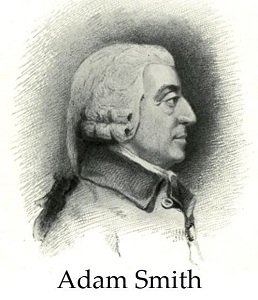
These classical economists now defined the economy as a special area that the state should keep away from. In recent years, ‘neoliberal’ economists have pushed things further. Theorists like Milton Friedman and Gary Becker argued that all aspects of human life should be seen in economic terms. Neoliberal governments, from Pinochet in Chile to Thatcher and Blair in the UK, helped turn theory into reality.
Even a brief look at this history shows how the very idea of the economy is heavily political. Thinking about economics has always meant thinking of the world in terms of property that can be owned and managed – whether by a rich ‘householder’, a king, or investment funds. We need to bear this in mind when thinking about ‘economic systems’. Do we want just to replace capitalism with another economic system? Or to destroy ‘economy’ altogether, and stop thinking and living like the world is there to be measured, carved up and dominated?
In and out: production processes
Now to capitalist economic systems. To start things off, it could help to work through a simplified example.
Imagine …a car factory. In at one end come inputs. These include raw materials like steel, glass, plastics, etc., shipped in from steel mills, glass plants, etc. There are also previously manufactured parts, e.g., electronic components or rubber tyres, which have already been assembled in other factories. These inputs are put together by workers — trained human beings — using machines, which need energy to run. Finally out comes a finished output, cars.
How many cars will the factory produce? It depends, amongst other things, on how much of the inputs are put in. For example, here are some (completely made-up) figures for a factory producing at full capacity:

Capitalist economic systems often involve division of labour: different workers specialise in different jobs, producing different parts of the process. They also involve division of decision-making.
E.g., the factory has a manager whose job is to try and get as much output as possible. The hands-on job of squeezing the most hours labour out of workers is delegated to foremen. Workers get to decide things too: which way to turn the bolts … or whether to throw a spanner into the works when no one is looking.
But the decisions about inputs are not just made by one company. The same steel, or workers, could go to other car factories, or to make toys or guns instead, or more car-making machines. Or the iron ore could stay in the ground, and people could spend their time living life creatively instead of working in production lines. How are these decisions made?
Markets
In the Soviet system, decisions about allocating steel to factories were largely made by planning commissions. In a ‘free market’ capitalist system, many of these decisions involve markets. In this example, a number of markets are involved:
• The owner of the car factory tries to sell its products to consumers
– in the car market.
• The car company, as well as other businesses producing toys or guns,
all need to buy steel – in the steel market.
• They also need to hire workers – in the labour market.
Particular markets can work in very different ways – e.g., labour markets might involve internet job sites, government jobcentres and training schemes, regulations such as a minimum wage and employment tribunals, or cash-in-hand work and gangmasters, etc. But all markets have some basic points in common including : sellers (supply); buyers (demand); and prices.
Unlike a planning system, ‘decisions’ in markets can be quite decentralised. Overall outcomes – what is produced, how products are distributed – are not made by one individual or committee, but may be the result of many actions by many different individuals and groups, often acting independently. For example, there are lots of different car factory managers, and lots more car buyers. Each one can make an individual decision about what to produce, sell, or buy. The total production of cars in the economy is a result of all these separate decisions.
And of many more decisions made in other interlocking markets. This does not mean that some people and groups are not more powerful than others in markets. It just means that power relations are more complex, and can be hard to identify.
Markets and Power
A monopoly is where there is only one seller in a market. A monopsony is where there is only one buyer. For example, the company called De Beers had until very recently a near total monopoly on the world’s diamonds. Monopolists do not have to compete with other sellers who might undercut them, so they have considerable power to set the price on their products; and so to make high ‘monopoly profits’.
An oligopoly is where there are a small number of sellers. These sellers may join to form a cartel which fixes prices by agreement. The OPEC cartel of oil producing states is an important example.
According to orthodox economic theory, the more sellers there are, the more the price should be bid down by competition. In a ‘perfectly competitive market’, with many sellers, the price would be forced down until it just covered costs, and there would be no profit at all. Orthodox economic theory often works with this idea that markets are perfectly competitive.
But in reality, such markets don’t exist outside textbooks. By controlling prices and production, big companies and cartels have power over distribution of commodities in markets. We can call this market power. In general, an individual or company has more power in a market the more resources – capital,money, or other commodities – it has to trade.
So, ultimately, market power comes down to owning stuff. But what does that mean? In many markets, ownership of resources is guaranteed by property law: the state recognises what resources belong to you, and can send in the police to back up your claim. So market power does not exist unless it is guaranteed by other forms of power: the political and military power of the State, which enforces property laws with violence; and the cultural power of the norms and values that keep us believing in private property and work, and desiring more and more consumer goods.
Profit
Most thinkers of capitalism, from Marx and Weber through to neoliberal economists, assume that owners of capital have one basic interest: the pursuit of maximum profit. In the other threads I will make, I will look at this assumption, and the very idea of capitalistic ‘interest’, in some more depth.
For now, though, assume that it’s so.
In our simple example, profit = revenue – costs, where revenue is the money made from selling cars, and costs are what the factory pays for all its inputs.
So, to effectively pursue profit, the car company’s managers need to think about a number of markets. On the one hand, it aims to make as much money as possible in the car market. On the other hand, it wants to buy the inputs it needs as cheaply as possible.
Suppose its market researchers predict that they can sell 1000 new cars at £10,000 each. That will be a total revenue of £10 million. The table below also gives some (again, imaginary) costs for inputs. The money spent on machinery here includes maintenance of wear and tear, replacement parts, etc. – what economists call depreciation.
The thing is that, usually, the car company will only get the revenue from its car sales after the cars are produced. But it will need to pay for inputs in advance. So it will have to borrow money to fund its production.
This brings in another kind of market – financial markets.
As we will see in the next thread, there are various kinds of financial markets, including bank lending, stock markets, and bond markets. They work in different ways, but again we have the same basics. This time the commodity being bought and sold is finance, i.e., money to lend. The ‘buyers’ are the people and corporations trying to borrow money; the sellers’ are the lenders; the price the borrowers have to pay is the interest rate. We will discuss these in the next thread.
For example, the car manufacturer needs to borrow £4m to pay for inputs. It agrees to pay back the money with 25% interest a year later, after the cars are sold. In the longer term, the car manufacturer probably also had to borrow to buy the machines and building for its factory. It will have to keep paying interest on these fixed costs, probably for many years.

Suppose the car manufacturer got it right and it can sell all its cars for £10,000 each. Then it makes a profit of £4 million. Governments may take some of that in tax. Out of what is left, the car company’s owners or managers now have a new decision: how much should they invest in expanding the business, buying more up-to-date machines, etc.? And how much should they keep for themselves to spend?
Things don’t always go so smoothly. If the factory can only sell 500 cars, or has to sell them all at half price, then it makes a £1 million loss. The input costs and interest payments still have to be paid. If the company can’t borrow more money to keep afloat, it will go bust.


From cattle to capital
Historians usually trace capitalism back to the 15th or 16th centuries; but the word ‘capitalism’ itself only goes back to the mid 19th century. The word ‘capital’ is older. It comes from the Latin capita, for ‘head’. In the middle ages, ‘chattels’ meant a wealthy person’s movable wealth, especially animals or livestock – including, where slavery was legal, slaves.
The term still survives in our modern English word ‘cattle’. So, perhaps capital originally meant ‘heads’ in the sense of the number of animals (‘heads of cattle’) belonging to an owner. The 18th century ‘classical economists’ identified three ‘factors of production’: land, labour, and capital. Capital now meant all other materials and machines involved in production. By the 19th century land was no longer considered to be a separate ‘factor’, just another form of capital. In the 20th century, with neoliberal theories of ‘human capital’ (‘intellectual capital’, ‘social capital’, etc.), some started to see human energy and skill as just another kind of capital too. We can also distinguish between physical and financial capital. Finance is not actual tangible stuff, but promises, agreements, IOUs, and contracts for using physical capital.
Capitalism – or capitalisms
From the simple example I have been working through, we can highlight some key features of capitalist economic systems, which will need to be investigated in more depth in the coming threads. These include:
• Markets. Decisions are made through many complex interactions of buyers and sellers in markets. In the next thread, I will look at some very important kinds of markets, the markets for finance capital.
• Commodities. Things that are bought and sold in markets are called commodities. Cars, steel, energy, and even wage labour are pretty obvious examples. But just what kinds of things can be bought and sold, owned and managed? One issue we will need to look at is how, over the history of capitalism(s), different kinds of resources have become commodified. For example, in 16th and 17th century England, and in the colonies, wild spaces and land that was traditionally held in common was forcibly ‘enclosed’ and parcelled up amongst landlords. More recently intellectual commons’, or even the genetic codes of wild plants, are being trademarked and patented, and so ‘enclosed’.
• Property. The only people who can buy and sell in markets are those who have ownership rights over commodities. Thus behind every market is a background of property rules – laws, conventions, regulations about who owns what, and what they can do with their property.
• The State. And behind property laws stands the state – ready to enforce them with violence.
• Profits. Much of the capitalist economic system, its power and invasiveness, is based on the pursuit of profits, which drives the commodification, appropriation, invention, production and spread of new commodities.
• Labour. Central to many forms of capitalism is the way that human time and energy is also commodified, bought and sold. This includes not just wage ‘labour markets’, but also forms of slavery, domestic labour, prison labour and more.
I have decided to start a few threads on this topic, based on a number of talks and discussions on capitalism i’ve done over the years. Sometimes, I start by asking people: what does capitalism mean to you? Here are a few words that often come up:
profit
banks
exploitation
markets
greed
wage labour
class system
supply and demand
consumerism
commodification
These words point out some common features of the world we live in today. I will look at all of them, and more.
Some classic definitions
But could we sum it all up in one handy definition? Here are a few classics by famous writers, dead and alive.
According to Karl Marx, the ‘capitalist system’ is a system of economic production which involves two basic classes of people:
‘on the one hand, the owners of money, means of production, means of subsistence,who are eager to increase the sum of value they possess, by buying other people’slabour power; on the other hand, free labourers, the sellers of their own labourpower[and who own nothing else except their own labour power’ (Capital Volume 1 Chapter 28)
According to Max Weber:
‘capitalism is identical with the pursuit of profit, and forever renewed profit, by means of continuous, rational, capitalistic enterprise’
(The Protestant Ethic and the Spirit of Capitalism, Introduction xxxi)
Marx and Weber being probably the two most famous bearded dead white man thinkers on industrial capitalism of all time. For a more recent definition, here is one from Keith Hart, a contemporary anthropologist who studies different forms of capitalism around the world:
‘that form of market economy in which the owners of large amounts of money [or,more generally, wealth] get to direct the most significant sectors of production.They do so in the interest of adding to the amounts of wealth they have.’ (The Memory Bank: money in an unequal world, p83).
All three definitions make important points. Hart’s definition helps point out that capitalism is a system of power, in which power to ‘direct’ the world comes from owning wealth and property. Weber’s definition focuses on how our world has become dominated by the ruthless pursuit of profit.
Both Hart’s and Weber’s definitions are focused on the activities of a crucial group: ‘capitalists’. Also known as ‘entrepreneurs’, ‘businessmen’, or owners (or managers) of the ‘means of production’, etc. Certainly, there is no capitalism without capitalists. But Marx’s definition adds a crucial point here: capitalists are in the minority; capitalist systems involve a number of different groups, or ‘classes’, often in struggle with each other.
However, Marx’s definition also has serious problems. He thinks of just two basic groups, capitalists and ‘free’ paid workers. What about the ‘unfree’ labour of slaves, indentured workers, prisoners, all of which also massively increased with capitalism? Or the billions of women and children doing unwaged domestic work? Through its history, capitalism has involved many different kinds of workers, slaves, peasants, consumers, unemployed, and other dispossessed people. Can we group all these together as one class? Or is it only waged workers, the classic Marxist ‘proletariat’, who really matter?
Another limit of all these definitions is that they focus on capitalism as an ‘economic system’. But capitalism is more than that. Capitalism isn’t just ‘the economy’. It shapes every aspect of our lives, all our ways of living and relating to each other, from love to war, even with our closest friends and loved ones, and digs right into our deepest dreams and desires.
Many capitalisms
Actually, I think there is no one ‘correct’ definition of capitalism. And it’s probably more accurate to think about capitalism in the plural. Over the last few hundred years there have been many capitalisms, or forms of capitalism. And, sadly, there will probably be more capitalisms to come.
Historians debate whether capitalism began in Italy in the 15th century, or the Netherlands in the 16th century, or perhaps Britain in the 17th century. All of these early capitalisms were different from capitalism today. And capitalism today is different in London or Nairobi or Shanghai, or in the South American rainforests or the Asian highlands.
And capitalism is not an all-powerful ‘monolith’. Capitalist systems co-exist, incorporate, work with or fight against other systems, cultures and forms of life.
For example with older feudal or tribal institutions, or with movements to create different ways of living.
In whatever form it takes, capitalism is not ‘natural’ or eternal. It is constantly changing, being re-made by human beings, and by the bigger worlds around them. The history of capitalism is a history of invention and creativity, and of destruction, exploitation, domination, bloodshed and terror. And also of resistance and rebellion and struggles for freedom.
With all these provisos, we can use the word ‘capitalism’ as a shorthand for some key features of how our world is run today. The aim of these threads is to try and understand these basic features. Understanding them will help us think about how to destroy them, and so help free ourselves to live differently.
Cultures and economic systems
To simplify things, I am going to look at two aspects of capitalism. In the first threads, I will start rather narrow and look at capitalism as an economic system. This is the traditional province of ‘economics’. Here I will look at how capitalism works as a system for organising the use, production and distribution of economic goods or ‘commodities’.
Here are some key features of capitalist economic systems:
• markets play a central role in making decisions
• property rights set out who can use and trade goods, and so have economic power
• things, animals, and people are made into commodities – objects that can be owned and traded
• the state acts as an enforcer of the economic system, and helps it spread
• concentrations of wealth, of capital, channel power into the hands of capitalist elites
• the profit motive drives capitalists to continually expand markets
• in modern industrial capitalism, profit very largely involves the exploitation of people who are forced to work
But to understand capitalism we also need to look at how these economic structures are dug in deep, in ways that affect every aspect of our lives. For example, capitalism as an economic system can’t function unless many people learn, often from childhood:
• the rules of markets, how to act as buyers and sellers
• to respect property
• to see animals, the natural world, other people, and even ourselves, as ‘objects’ to be bought and sold, owned and managed
• to respect and fear the state, its laws, police, judges and teachers
• to accept gross inequalities of power and wealth
• to believe that accumulating ‘stuff ’ is the key to happiness
• to base our lives around work
To highlight this point, we could say that capitalism is not just an economic system but also, and more deeply, a culture or form of life. That is: a complex web of desires, values, norms, conscious and unconscious rules, practices, behaviours, attitudes, that are shared and spread in the social groups in which we are born, raised, and live our lives. In later threads on this topic, I will look further at these crucial points.
I have opened up this thread for now, although it is not strictly speaking active. I wanted to share some intitial thoughts after reading the introduction and some of chapter 2, the introduction is chapter 1 by the way.
The book is very easy to read, I think it is by far the simplest book on Wittgenstein (as he has been the main philosopher to be discussed up to this point) I have read so far.
It is painstaking in detail when it comes to comparing Saussure’s structural linguistics to Wittgenstein. I like how it clarifies the embodiment of rules in language, which is interesting.
Anyway, that’s a very brief skimming through, first impressions type post. I will not be posting the PDF, as I don’t have it, any readings from this book will have to come from a physical copy, or your own PDF if you have it I am afraid.
I liked the idea of this kind of section on a forum, a place where members can write an essay, a play, movie script, poetry and more, if their topic does not or does fit into the general themes of the rest of the forum.
Overcome your writers’ block here!
This is some text I found on my PC. It was answering a video that had a guy I know called Nick, asking an ‘astrologer’ about astrology.
Hi Nick,
Here are the questions you asked in the interview and my responses. I will attempt to keep them as simple and as short as possible.
As regards the first points of “bettering oneself” and astrology being about “you and your sense of self”, that is pretty much a decent perspective to take with it and why it is worth taking a look into. The aim of a reading is to find positive affirmations about an individual.
1. Are there 12 houses and signs/are they the same thing?
The signs and houses are different. The signs are 30 degree divisions of the ecliptic in space(the ecliptic is the path of the Sun), which is an invisible horizon in space, kind of like an equator. The houses represent the relation between the ecliptic and the equator down on Earth. The roots of this type of astrology come from Hellenistic, Egyptian, Babylonian and Sumerian culture in the West.
We can gather a basic understanding of the horoscope from spherical astronomy.
The houses are not strictly 30 degrees and can vary in size, sometimes containing up to four signs of the Zodiac within them, this is due to the rotation of the Earth on its axis (tilt).
We could picture a gyroscopic movement system for the signs in relation to the houses and the equator, Signs pass through houses depending on the axis of the Earth and the time of year and day. It is from these movements that we obtain the four most important angles of the chart – the ascendant, the immum coeli, the descendant and the mid-heaven.
Whatever sign is on the cusp of each house will be the ruler of that house in astrological interpretation, the most important of which is the ascendant, as the ascendant represents the sign that rises in the East at the exact time we are born from the perspective on the Earth that we occupy at that moment, this is why it is sometimes referred to as the “rising sign”.
The perspective of the natal chart is that of looking due South, the mid-heaven is always due south, with the East to our left and the West to our right. The immum coeli which is directly opposite the mid-heaven, is referred to as the North. The best way to picture what a chart actually is looking at, is if we imagine that the Earth is rotated so that the area of the Earth that we were born in is directly on the North pole, so that no matter which way you face, you will always be looking due south. The North and its meaning is important to understand in astrology, it represents the “higher self” although I prefer to use the term “authentic self”. Understanding the Northern meaning and definition, symbolism etc, is paramount as it will help us to unlock the nodes of the Moon, a North one and a South one, but we can get to that another time, I don’t want to overload you.
In summary, the houses and signs are relative to time and space, the relation between the ecliptic in the sky and the equator down on Earth. The philosophy of Hermeticism states “ as above, so below”, this is what it is referring to. I have some disputes with this type of philosophy, especially its relationship with Gnosticism and Plato. I can go into that another time.
It has nothing to do with the constellations, they have moved into sections of the sky that are less or more than 30 degrees and the signs and houses are not the same as the constellations.
2. As constellations move or stars within them burn out and general cosmic flux occurs, does that change and affect astrology?
This is the scientific criticism of astrology, that the stars the ancients pointed to are not in the same places or that they no longer exist, therefore if the stars have an effect via emanation, it therefore emanates from nothing. Flux does occur and stars do move, stars go super nova and burn out. The answer to this question is in the first answer, it is not the constellations that we are pointing to, it is the signs and the houses, these are completely intangible measurements in the sky.
The first 30 degrees of a horoscope, which is the first 30 degrees that is directly to our left in the East below us on the 21st of March each year, which is the spring equinox at 6 am in the morning, is the first house and the sign of Aries, it will always be that sign and house at that time of year and day when the equinoxes of the Zodiac signs and houses match up together. It is not the stars, it is the angle of the ecliptic in relation to the equator divided up into 12 sections that we are pointing to.
As regards “predictive natures”, I would like to expand on what I define astrology to be. I agree with the Oxford dictionary on the definition of astrology – “the study of the movements and relative positions of celestial bodies interpreted as having an influence on human affairs and the natural world “ – I will also refer back to what we have opened the idea of astrology to be, to find positive affirmations about the individual, which gives us a non-predictive system and more of a method of defining the means of our fate, rather than a forecast that indicates the ends, the pot of gold at the end of the rainbow. This is where we must use philosophy to decide what we see the world as. Do we see it as being entirely determined, or is there autonomy of will that is subject to change? Is there a prior purpose to life, or does the meaning come after the fact? These are all the essential philosophies that require devout intellectual contemplation if we are to take astrology seriously/
Astrology is just like another language, it has symbols that we use to point out an example, therefore it is an ostensive definition and since we have altered the way it used from predicting agricultural actions to predicting the outcomes of a kingdom and its rulers, sovereigns and noble men, which had a very limited amount of possibilities and the mystics were often bribed by politicians to set battles and corruptions in motion, to out Jungian view of astrology today, we can see how astrology has stood the test of time and is capable of adapting to new ideas and collective memory. It is like an eternal storage device of history and collective memory.
It just depends what examples you are pointing out using the medium of astrology, it’s an inert system on its own, it requires a meaning, a context, subject and emphasis to work.
We could say that it is hardly ontological (as in “what is”) and more of a theory of what is, making it epistemological. This is where I have disputes with Gnosticism, Hermeticism and Platonism, the theory is often confused with the object it is pointing to (which is usually not really an object but a concept that has been turned into a world or God of some kind), as this type of ideal often becomes overly rationalistic, therefore the means are confused with the ends, the object of absolute truth recedes at each effort to reach it and we can infinitely regress towards a source that does not tangibly exist. I will get into these criticism another time however, but it’s important to “not watch the finger” when pointing.
I feel it is imperative to ask where meaning comes from, astrology is great way to open up this question and find the balance between criticism and allowance to understand and accept, we need to suspend disbelief of course, but we also don’t want to make too many assumptions that have no basis in our own personal knowledge, we should start from the ground up, rather than looking out mindlessly into the stars for an ideal state of being that is absolute and fixed. Loss of humility is common in mysticism on this basis alone.
Using terms like energy can become tautological (true as it is repeated more than once and is everything therefore nothing at the same time), I believe that collective memory is created by man after the fact and is placed into language which can support itself without reference.
3. What are the different types of astrology?
There are two main types of astrology that I practice – Draconic, Placidus and Astropsychology as the method for interpretation, however I have evolved this into “Existential Astrology”, which is combining the theme of existentialism ( a philosophical theme that addresses the ontology of the human existence, the purpose of it and values, drives, emotions, flux and will among other themes.)
There are various types that are subtypes, like composite charts, where we take two charts and read them as one, synastry, which is the chart used for relationships, progression astrology and various other techniques like interceptions of signs and houses.
In the East there is the Vedic tradtion, although there are many others like 13 sign astrology too.
I will not go into details here as the questions was more of a “make a list” type question. If you would like to know more about these, please ask and I will go into them in another video or essay.
4. Astrology forecasts are like weather forecasts and are 50% wrong all of the time.
I take it that you are referring to mundane astrology, which is an astrological practice that allegedly “predicts” events in politics or general collective energies. This is a little trickier, the only mundane astrologers that I have any time for are those who have been making notes of relative eventualities and event relationships over a period of 20 years or more, that is the only way to offer a forecast that is worth anything in my opinion, but it is not an exact science, there are so many different outcomes happening across the world in relative cultures that we could say astrology is responsible for anything. I prefer to be much more specific and focus on individuals.
The maturity of a human is around the age of 30, this is the end of childhood and the start of being a responsible adult, it is also an anxious time when we feel we need to “do it now or never do it”, we put ourselves to the test and decide our own values and act upon our desires and drives. It so happens that Saturn returns to the exact point where it was on your natal chart around this time and so from this occurrence, we attribute Saturn to this phase of profound liberating change.
On the collective level, the world is just too vast to be specific with mundane astrology, predictions in medieval times were in very limited domains, there were only so many things that could happen to you, where as our complexity has far surpassed this “science”, which I should indicate here means “knowledge” and “gnosis” means “Science of things divine”.
I don’t agree with a prescriptive interpretation of astrology or a determined outlook as it does not focus on individual will, I prefer to be specific and only interpret individual charts, I don’t predict either, I create a “portrait” of that person. I often ask for the native of the chart to provide information about their life and then I place that information onto the chart, this way I can study it accurately with actual, rather than idealist events and occurrences, it is through this concrete data collection that I have been able to find similarities between aspects. I am humble however and can’t give you an answer as to why similar aspects often have similarities to each other in different charts in the way they manifest in the actual, I just can say that they do, I will not say it is an “energy” or “force” that is determining this, we will get to this in another question I heard.
I wouldn’t call it a science, I would call it a methodical language to describe the processes of human existence, it’s an art form, hence why I call my readings “portraits”.
We have to be careful when people claim to have knowledge of things that haven’t happened yet, they can become overly moral with lots of “should, ought and should nots”, I don’t see astrology as showing anything in the future or the past, I see it is showing what is always present in the now, as that is all we can say a human is, a being that experiences now with what they have as they are.
5. What happens when we get incorrect predictions, although we are sure that astrology is accurate?
We do of course have to have some common sense, astrology is describing a human being, therefore it contains all of things a human being has, mainly the way a human interacts with other humans, this includes the identity, values, drives, emotions, agency, intellect, will, creativity, criticism, service, the ability to relate, to fulfil dreams and desires, to make aims and to experience the world, to interact on the social level, get jobs, education, experiences, travelling, friendships, involvement, self belief, faith, hope and allowance or acceptance, so of course it will relate to anyone. A true astrologer will only be able to make assessments that are true or as true as possible if they have lots of experience, have made lots of notes, discussed it a lot and read volumes of astrological literature, it does not just come overnight from a source outside of the material existence.
We can often get lost in “what we want to hear” instead of “what we are”, astrology can often mislead people into thinking they have a preordained purpose and that they are special in such a way that they are superior, this is what many will want to hear in predictions.
The only resolve is revaluation and to ask what we want ourselves, this is why I ask for information from the native of the chart as it is the subjectivity of the individual that we are looking for, how they can express their own will as best as they can.
6. Is astrology too general? Can this chart be anyones?
Astrology will tell you nothing new about yourself, I see it as a gateway to begin questioning yourself, to develop your curiosity, this is a life long pursuit, it requires care and honesty. Many will entertain it and stop here, as they want quick answers and certainty.
This is why I introduce philosophy into the astrological interpretation, I often talk a lot about Friedrich Nietzsche who has some great works that are similar to Daoism and Buddhism, of which these other ideas and concepts are what astrology never really gets to on its own, as it is merely pointing as a methodical language.
Astrology does not support itself, it can be everything, therefore it is nothing at the same time, this is the irony and paradox that has no definitive answer, it is a philosophical question that is always present in many religions and spiritual ideas.
I believe it is more beneficial to say “philosophy happens after the fact”, rather than to look at the being we are describing in the chart as a pre-existing entity. Start with “what is”, rather than “what if”.
7. Differences in Western and Eastern traditions?
This is a tricky subject, sometimes we can interchange with opinions and beliefs depending on the astrologer of the type of astrology they use. It all comes down to world views. Do we believe in other worlds having influence, is it all conceptual, abstract, are we looking at previous lives, or are we looking to achieve a goal of some kind? These are the many issues at play here.
East and West are always very different in the way they think intelletually, the West has a view of substance of all things and is very rationalist, ideal and absolute in its methods, whereas the East is more focused on practices, some ascetic, some moralist, but mostly they are more inclined to process, karma and other-worldly and other life influences. As I said before, astrology is not a self supporting language and is ostensive in definition, it just depends on what you claim to be pointing at.
8. What if two people have the same chart?
This is the question that inspired me to answer you, a natal chart is like a finger print, each one is unique. However when we have two charts that are the same, it doesn’t mean they will turn out the same.
We have to think in terms of relativity. Two people may well have the same chart, but not the same upbringing, one may be a King, the other a Hippie, therefore the manifestation of the aspects is interpreted to accommodate those relative outcomes, we are all individuals, but this is not to say that “manifest” means there is an original idea, that would just be our self-supporting language confusing the issue, all we can say is that the charts are the same, but the people are not. The astrologer and indeed all of astrology is about finding a medium to communicate and experience people of different cultures. To look at each other equally and with empathy by describing ourselves as the cosmos is a humbling experience, this is where we upload our collective memory, by using astrology to point out to the stars and say that they are like parts of us, like a metaphor, allegory or concept.
We have to take into account perspective – what can we see? What do others see?
They may well have similar traits, again I can’t say that they would, but they would not be the same person entirely in all probability due to their experience of the world.
9. There are so many people who claim to be astrologers, how do you recognise a “real” astrologer?
It all depends on how interested the audience of that astrologer is, if you really want to know if they are genuine or not, then they will be able to openly discuss astrology with you.
It’s a tough question really, as I look at astrologers (real ones) as philosophers, rather than prophets or predictive mediums. If they only seem t have one way of emphasising the chart, then they are probably not that well informed, or if they constantly talk generally, non-specifically, make lists and just list the movements of the aspects, then I am always wary of them.
I like to have a little transparency with astrologers, I want to know what they have read, where they get their ideas from and if they are Platonists or not. Those who hype people up with doomsday predictions and claim to have medical knowledge from astrology are to be avoided. Cult like astrologers are usually noticeable as they take it too seriously, an astrologer should be fun and not full of morality, they should be humble and intelligent, eager to read and to discuss astrology.
Astrologers that get people together to defend their territory on the web are fake as hell, those who are caught out defending themselves are usually fakers.
The only way we can judge them is with our own knowledge of astrology, if you don’t want to be conned, then read some astrological literature.
I have made a few tutorials online that are totally free and they contain the most information about readings that I know of. Fakers usually keep things exclusive and don’t discuss how they read a chart.
I think it’s also important to know how they define astrology too, just like when people say they are scientists or philosophers, you have to ask what they mean when they say these things.
Astrologers and high and mighty spiritual people who want to make money will always push the blame onto those practice their theories of what they “ought to do” in order to say that they are not doing it right and so that they can perpetuate the fear of self expression. They get very arrogant.
10. How can I learn more about astrology?
READ! READ! READ! I recommend Joanne Wickenburg and Liz Greene, I also recommend learning more about philosophy, especially Plato and the history of astrology and Hellenic culture.
I think it’s also important to take the opposing view and ask what the problems are in astrology, if it isn’t true on assumption, what would the implications be?
Astrology is ostensive definition, you use it to point out an example, you just have to have a wealth of knowledge to point to. You can learn the general processes of astrology to place your ideas onto it and then you have a kind of leap of faith with it and let your intuition loose.
Ok, I am going to wrap up here, any questions, please feel free to ask. 🙂
Amendment : What are the principles of 13 sign astrology?
Western tropical astrology has long been detached from the constellations eponymous of the signs, due to the axial precession of the equinoxes over the centuries since the introduction of the zodiac by the Chaldeans. By contrast, in sidereal astrology the astrological signs remain attached to the constellations, while the vernal equinox has moved away from Aries over time. Sidereal astrology has traditionally only been practised in Indian Jyotisha, but it has been introduced in western astrology by Cyril Fagan in 1944. A small minority of western astrologers have since followed Fagan and used a sidereal system as in Indian tradition. – Therefore 13 sign astrology is calculated using sidereal time, which is used by telescopes to judge their position using the fixed stars while earth rotates along its orbit, this varies as the earth orbits wider and wider. The 13 signs are along the ecliptic and using the sidereal method, we get 13 signs of the zodiac. I also looked into Babylonian astrology that used the orbit of the moon (13 orbits per year) which was used to calculated the months. I personally prefer to use 12 sign astrology, but many say they don’t match the description of Sagittarius and feel more like Ophiuchus.
If we were to be more materialistic and we view the constellations as having any effect, then I suppose 13 sign astrology fits the bill, but this is still very Platonic and idealist to me. We can use a vast number of different measurements to determine the principles of astrology, it just depends on the context. Draconic charts are created to have more emphasis on te nodes, but they are not an accurate measurement of the sky and tropic.