)
Another upload for a future reading, please comment if you tackle it in the mean time.
I have uploaded this for an official discussion in due time, but if anyone wishes to tackle it, please feel free to leave comments here.
Before I read any Derrida, I stumbled upon this thinker. John L. Austin was a British Analytic Philosopher of Language. Along with Wittgenstein, he proported Ordinary Language Philosophy – Ordinary language philosophy is a philosophical methodology that sees traditional philosophical problems as rooted in misunderstandings philosophers develop by distorting or forgetting what words actually mean in everyday use.
More on that soon when we tackle this book: https://ontic-philosophy.com/Thread-Derrida-and-Wittgenstein-Garver-Lee
What drew me to Austin was his Speech Act Theory – I am a critic of freeman on the land, or to be more precise, the movement that has taken root on the internet that tries to sell people the idea there are ‘magic words’ that make you immune from the law and so deciphering legal texts becomes a necessity. In doing so, I noticed how philosophical texts and legal texts have lots in common. They have succint definitons that are capitalised and defined in an index before or after the main document, so if an ordinary word is used but it is ambigious, a capitalised version of the word can be used to maintain a single usage that is specific to that document. I came across some terms used by Austin because I was investigating one of the magic words that freemen believe gets them out of trouble, which is ‘overstanding’- which has a historical meaning from Rastafarian cultures and black supremecists, it’s a kind of ‘anti-authority and oppression’ statement, but the other usage was in some Hermeneutic texts using Austins ideas and it was all about how to interpret religious texts that formed religious laws and so they assert, promise and demand etc – these are what Austin calls illocutionary acts.
Austin is best known for his Speech Act Theory – the theory that utterances of words in language not only describe (constantive speech) facts about the world, but they also do things too (performative speech).
Derrida takes this Speech Act Theory to show how certain statements in the Declaration of Independence of America are undecidibly constantive and performative – one can’t say for sure whether liberty is described or created by the speech act.
The most fascinating aspect of this performative turn of linguistics, is that it can combine force with ordinary meaning. An illocutionary force of an utterance is the speaker’s intention in producing that utterance. An illocutionary act is an instance of a culturally-defined speech act type, characterised by a particular illocutionary force; for example, promising, advising, warning.
This explanation of force and meaning through performance radically influenced feminist philosopher, Judith Butler, who introduced the performative turn into feminism too, she shows how sex and gender are culturally articulated norms through repeated performance and combined with Foucaults’ analysis of power, she breaks open the reified structures of our discourse of sexuality and opens up a space for novelty. This superstructural project is much like any other structural project, society, culture, our Unconscious, are all structured like a semiotic linguistic system – that is structured like a language – we are formed from the outside through the accepted rules of language before we learn language itself and this radically decenters us from our experience.
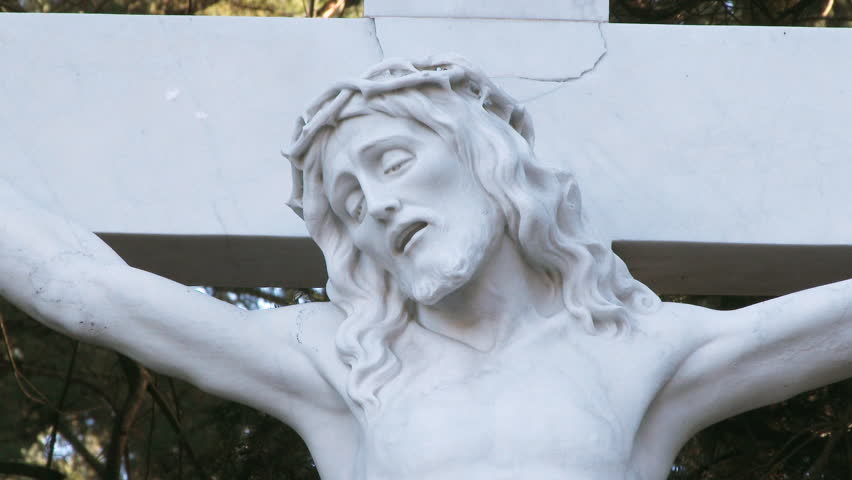
Around the Medieval Period, the depiction of Christ on the cross would show him with a titled head, usually down towards the right side. It is interesting because it is conveying the very moment of death. Sometimes the tilt is subtle with a gaping mouth, which gives the impression that he taking a final breath.
This is what makes this symbol so powerful. The immanenece of death and in Christian terms, the death of Christ was the payment for our sins, bringing with it a debt of guilt imposes our fate in a way that is hard to ignore. We are not only contemplating the eventuality of death, but the moment of passing, the moment when life ends and death begins, although one could say this symbol reminds us of how every moment is living and dying and breath (the etymological root for spirit) is the indication of this inhaling for exhaltation and exhaling for the fall.
This PDF that @”thetrizzard” shared made me think of this: http://www.unm.edu/~ithomson/Thomson.pdf
This really cool, huge image of a peasant woman with a chicken in her arms is just around the corner from me.
Love of wisdom
The most general definition of philosophy is ‘the most general and comprehensive type of inquiry’. What is inquiry? Let’s say, ‘the attempt to say what is true and why’; which is to say ‘what is true, must be justified by reasons and/or evidence’.
Philosophy leaves nothing out, except for the particulars that other sciences and what their own specialist established methods investigate. ‘What is the cure for cancer?’, is a very important question. This is not a philosophical question however.
If you ask ‘what is health?’, or ‘what is a cause?’, or ‘how many many social resources should be devoted to curing cancer against other social aims?’; all three of these are philosophical questions.
First philosophy
This refers to two philosophical sub-fields:
[list=1]
[*]Epistemology – the theory of knowledge
[*]Metaphysics – the theory of reality
[/list]
These two sub-fields constitute a very important family of inquiries. Such as:
[list]
[*]What is reality?
[*]How do we know reality?
[/list]
Other related areas that we may stray into are:
[list]
[*]Logic
[*]Philosophy of language
[*]Philosophy of science
[*]Social philosophy
[*]Political philosophy
[/list]
The latter impact first philosophy. Social and political changes sometimes alter the atmosphere in which first philosophy is done. For example, you can’t understand the development of the very abstract philosophy of German Idealism without recognising how the German Idealists were influenced by Jean Jacques Rousseau’s political philosophy and, by the French Revolution.
Modern philosophy
This arguably began with the 16th or 17th centuries as Medieval institutions and Medieval ways of thought, began to give way to the modern world.
Many thinkers are radical and controversial to say the least. My reading will differ from the reading from other commenters and philosophers – this comes with the territory of philosophy.
Great does not necessarily mean ‘right’.
The best a beginner can hope to achieve is to become familar with the whole forest and basic familarity with some of the biggest, distinctive trees.
To do this, you want:
[list=1]
[*]To be able to see three of four most basic claims of a philosopher on a topic
[*]Understand those claims as clearly as the philosopher proposing them does (sometimes, more clearly)
[*]Understand their contraries. To understand a term or position, you have to automatically ask ‘what is the opposite to this claim?
[*]Understand the main arguments or reasons for each of these basic claims of each philosopher
[/list]
Basic issues
What exists? What is the population of reality? Example: Much of reality seems to be material and made out of matter. Is it all material? If all reality were material, that would raise many questions immediately.
[list]
[*]Does the human soul exist?
[*]What about numbers?
[*]Does the human mind and personality exist? Is it nothing more than the brain? Or is the mind different from and more than the brain?
[/list]
Suppose the mind is the brain.
As a physical system, wouldn’t the brains output simply be determined by its input? How could a material system like the brain, have free will? Lacking free will, how could it be a moral being, or be subject to moral responsibility any more than say, a Lion is subject to moral responsibility?
We often hear of criminals, especially murders and serial killers trying a defence in court that tries to say there were physiological problems about their own bodies that caused their actions. If this is true, then we can then ask if our normal behavior is also governed by chemicals, are we also not responsible for what we do?
From a genetic perspective, Lions are genetically programmed to eat other animals, we don’t blame them for doing so. From a Darwinian perspective, we are also animals and with our own genetic programming.
If the mind is on the other hand, not the brain, if there is a non-physical, non-material part to us called ‘the mind’, how in the world can it interact with the physical world? This includes the physical brain that it presumably depends on.
Another problem raised by science is that the physical world that physics describes is vastly different to the world you and I experience. The table and chairs around you are mostly empty space from the point of view of physics. They don’t appear to be empty space from our point of view, in which case, which ones are real?
The one science describes, or the one we experience and use?
Are there values in nature, if nature is entirely physical? Or are the values, like ethical values we assert, simply human projections and imaginations that have nothing to do with any other reality?
Bertrand Russell once wrote on the perspective of reality from the point of view of modern science.
Even more purposeless, more void of meaning, is the world which science presents for our belief…That man…his origin, his growth, his fears, his loves and his beliefs, are but the outcome of accidental collocations of atoms…These things, if not quite beyond dispute, are yet so nearly certain that no philosophy which rejects them can hope to stand. Only within the scaffolding of these truths, only on the firm foundation of unyielding despair, can the soul’s habitation henceforth be safely built.
If it’s true that modern science can do these things, if he is right, then that leads to very stark, metaphysical implications about reality and our place in it.
All of this pressuposes that we have knowledge, or at least a scientific knowledge of an at least partly material universe.
[list]
[*]Epistemic Realism – The view that our knowledge is true of its objects independent of our ideas, theories, and cultures.
[/list]
When our knowledge is true, it is true of things that exist independently of itself. Do we have such knowledge?
[list]
[*]Antirealism (relativism) – Our true knowledge is made true not by objects independent of us, but by our own ideas, perspectives, theories and cultures.
[/list]
In other words, the only validity we ever find in our knowing, is when the knowing fits in with our other ideas. This is the claim that says: we see things as we are, not how the things are.
We do have true beliefs from this point of view, but true just means ‘true for us’, ‘true for the holders of our theory’ or ‘true for the members of our culture’. This means there could be equally valid truths that contradict each other. There is no other universal truth, or truth in and of itself to speak of.
[list]
[*]Scepticism – Doubts that we have true knowledge at all.
[/list]
The sceptic points out that even in science, we keep changing our theories. If replacement makes a theory false, then contemporary theories, if they are destined to be replace also, will be false too.
How do we get knowledge?
There are methods and limits. Does it come from sense experience entirely, if so, there are many things we ought not be able to know because they are unexperiencable. Or, is there another source of knowledge in addition to our sense experience?
Other questions arise in epistemology and metaphysics:
[list]
[*]Does God exist?
[*]Is belief in a monotheistic God compatible with our knowledge of the world?
[*]Does history exhibit a pattern of development, or is it random or cyclic?
[*]Can all reality be reduced to the study of physics?
[/list]
All of these questions are provided by the unique conditions of the modern world.
In the Medieval period, all fields we know as the naturalistic and social sciences were part of philosophy. As they developed their own special methods, they split off from philosophy to form their own disciplines.
I will conlcude this thread and willtalk about the political aspects in the next thread.
Here is a short essay by Zeynep Direk on some concepts from Simone De Beaviour, please feel free to comment on it here.
I live in the UK, which is a sort of socialist/capitalist mix, but over recent years, it has started to become more and more capitalist.
Work
As a child and in my teens, my father and the rest of my family for that matter, would drill the capitalist work ethic into me. I was taught very strict limitations of what I could and could not aspire to. Basically, everyone says ‘you will be a laborer forever’, so you better get a driving licence and whatever skills you need to get jobs in warehouses, or factories, joinery etc – manual labor is the pinnacle. Of course, one can become self-employed, but that doesn’t make you more independent really – you are still just a skilled laborer with no one to answer to and no safety net to fall back on.
I have worked at 300 different companies in my life, through agencies mostly. Agencies used to be in the background of the labor market, you could go to them when you wanted quick cash, but you wouldn’t normally go to them for your first port of call – you would always try and seek a full time job.
I’ve worked at some very corrupt places in my life – companies that bury asbestos underground, have terrible health and safety, lots of tell tales who want to get you fired and lots of bosses who really don’t give a shit about you. I’ve seen violence, been on the receiving end of violence from workers and bosses alike, but most of all, these companies were boring – so much so that I had to take drugs to have the will to go into work everyday.
When I decided I had had enough
I was working as a Pizza delivery driver with my own car and the wages were awful – there really wasn’t anything else to go for at the time and the job market was falling apart. I had a job as a security guard and a CCTV operator and both of those places had employees that tried time and time again to get me fired so they could have more work!
I quit my job as delivery driver and signed on to benefits after working on different jobs for 15 years – I decided enough is enough – lots of existential problems hit me hard, like ‘why am I paying for this home and car, is this all there is to life?’. I was in massive amounts of debt just trying to stay afloat and I had just got completely fed up, nothing ever seemed to change. I gave the car back to the loan company and I felt free for the first time in years.
It wasn’t until I hit rock bottom, my mother passed away and I got myself a criminal record that I finally started to calm down and rethink my course in life.
Progress? What a load of crap.
I always thought of my life as a working-towards-the-plateau – that at some point, I would find a job and make enough money, then things would just settle into a routine and I would then be allowed to explore what is more than the life of a skilled/unskilled laborer in this life, get my pension and die.
I realised that if I didn’t work, nothing changed anyway, I could do what I wanted to and it didn’t matter if society thought I was being lazy – they are all as unhappy as I am, so I rejected their ridiculous work ethics. I was so resentful of life and others, to the point where spite was the means of interaction – I wanted to destroy myself to get away from this stupid system that everyone says we MUST comply with, but why? It’s really stupid.
It was around this time that I found the occult and philosophy and saw just how envious people are, they frown upon reading and intelligence, as it’s something they can’t relate to, they can’t touch something about you all of a sudden, I was able to rise above them all and when I saw how petty and meaningless the life of the others was, I decided to create my own spaces to move in to.
I was not interested in jobs and the demands of the job center any more, just being near government officials was enough to make me feel ill. I eventually signed off and moved down to London with my partner and we live a very creative life, I write all the time, make videos, make music. I still work, but I am self-employed – you don’t have a choice in that in a captalist society of course.
The main thing is that work is no longer the most important thing to me in life, there is more you can do if you put your mind to it, but I can totally understand those who have hit rock bottom, as I have been there – I don’t blame them, it’s the system we unconsciously uphold that is the problem.
Sentences have propositions in them but sentences are not identical to propositions.
If I say ‘the bottle is on the table’ that is a sentence with a proposition, which can be said in another language, or in a different way – ‘the table is positioned underneath a bottle’.
Possible worlds are full of propositions, but propositions are not in the world and are not the sentences they are in, so what are they?
Most philosophers say they are abstract objects, Plato said there is a world of universal forms, but others believe they bloat ontology.
Generally, we explain phenomena as being a ’cause and effect’ system where correlations imply causation.
What other alternatives are there to this model?
Here are a few I have been exploring recently:
[list]
[*]Constraint and limitation
[*]Response
[*]Reaction
[*]Emergence
[/list]
Are you aware of any others?